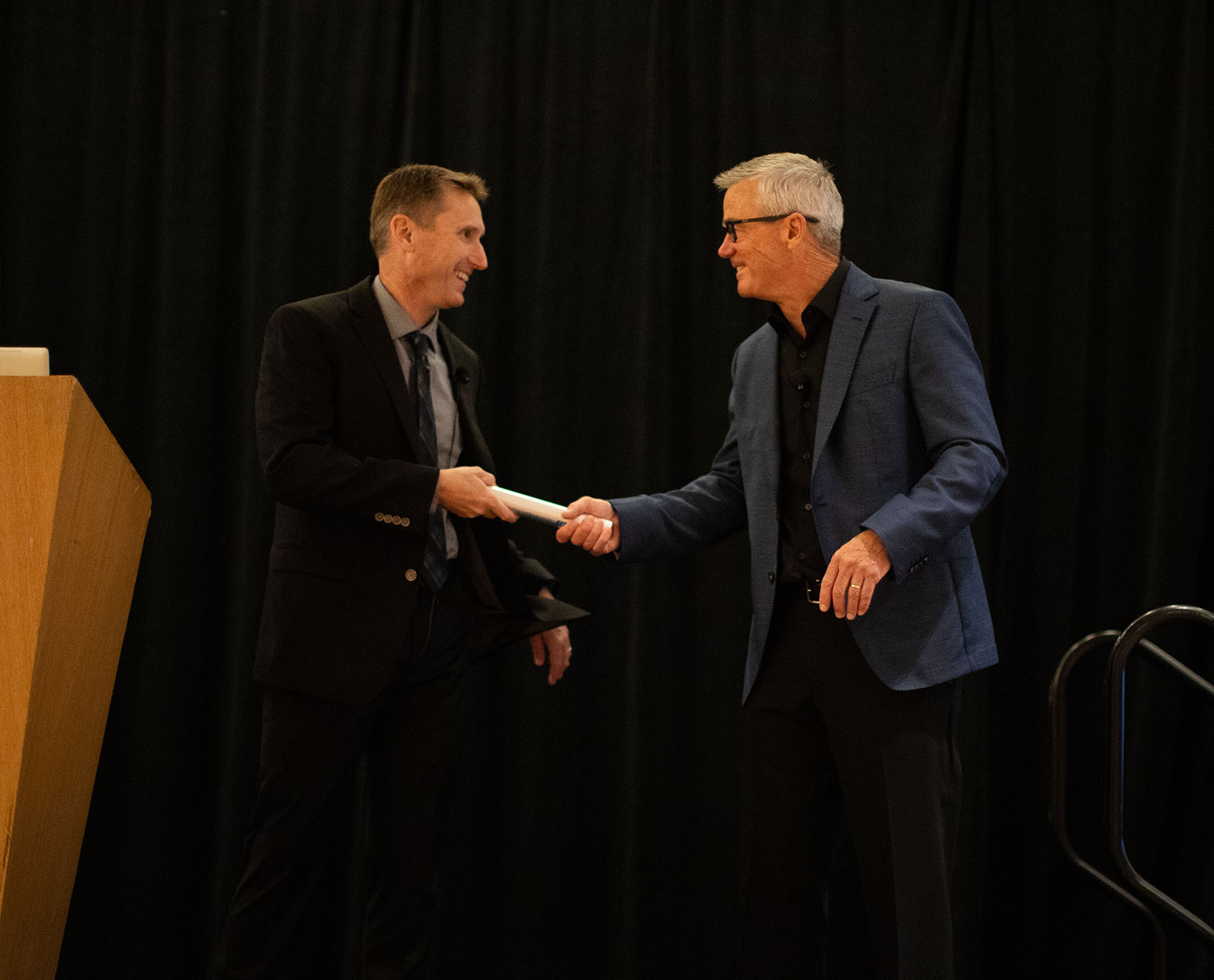
We’re excited to share an important milestone in KPFF’s leadership: Scott Kuebler has stepped into the role of President and CEO, effective June 6, 2025. Scott succeeds John Gavan, whose thoughtful leadership has left an enduring mark on our firm.
At KPFF, leadership transitions are rooted in our commitment to Stability and our responsibility to plan ahead for the future of our people, clients, and partners. This change reflects years of deliberate planning, collaboration, and care, with John and Scott working together closely.
To ensure continuity and a smooth transition, John will take on the role of Executive Chair, offering his guidance and support as Scott begins this next chapter. “Scott is gifted both at empowering others to bring their best and in building systems that support a growing organization,” John said. “He is the right leader to balance independence and support for our talented team at scale.”
Scott brings 27 years of experience and a deep dedication to KPFF. He’s a trusted voice and a proven leader. Known for his expertise as a Structural Engineer, Scott has played a central role in bringing innovative solutions to our clients while consistently advancing KPFF’s mission of engineering excellence. He has led our Special Projects Group since 2021. “It’s an incredible honor to step into this role,” Scott shared. “I’m now in my 28th year at KPFF, and I have deep respect for the people who make this organization what it is—our leaders, our staff, and those who came before us.”
Scott understands the rhythm of this organization, and we’re confident he’ll guide us into a future full of opportunity and growth. As Scott looks ahead, he’s energized by the path forward:
“What gets me most excited about KPFF’s future is our incredible people who show up every day to make a difference for our staff, our clients, and our communities. The freedom and support we provide to help our people achieve their full potential differentiates KPFF and fuels us to do great things. I really believe there’s no limit to what we can achieve if we stay committed to empowering our people.”
We would also like to take a moment to recognize John for his incredible contributions during his time as CEO. John’s steady leadership has shaped KPFF into the organization it is today, ensuring we remain rooted in our core values as we continue to grow and evolve. Over his 14 years as President and CEO, KPFF has doubled our number of offices and the size of our staff. Our ownership group grew from 60 to over 100, and our revenue tripled. John also helped define our purpose and vision, guiding KPFF’s future. In Scott’s words:
“John’s legacy comes from the influence he had in preparing the next generation of leaders to perpetuate KPFF. The most essential mark of a great leader is leaving things better than you found them – and John has done exactly that. We’re deeply grateful for John’s commitment and the lasting impact he’s had on all of us.”
Please join us in celebrating John’s legacy and in welcoming Scott to this new role. Together, we’re entering an exciting chapter for KPFF.
Editor’s Note: This piece was co-authored by NBBJ Principal Andrzej Czech and Associate Sandra Lozano, and KPFF Principal Mark Hershberg and Associate Maikol Del Carpio, and was originally published by NBBJ.
Earthquakes cost the nation an estimated $14.7 billion annually in building damage and associated losses, especially in hotspots like California, Alaska and Washington State. Buildings constructed before modern seismic codes—such as pre-1980 non-ductile concrete buildings and wood-framed “soft story” structures—are even more vulnerable to damage due to outdated construction methods. The solution? Seismic retrofitting. The process of strengthening a structure to make it more resistant to earthquakes, seismic retrofitting has gained momentum in recent years due to several policies and ordinances introduced at the state level to improve seismic safety, as well as a clearer and more precise understanding of seismic behavior.
In addition to making buildings safer and less prone to damage, seismic retrofitting also provides the opportunity to revive an outdated building, and can open the door for improvements in other areas without significantly increasing cost or disruption. Here, we explore how to determine whether your building is a good candidate for seismic retrofitting, as well as techniques and solutions that meet today’s standards while enhancing building performance, functionality and aesthetics.
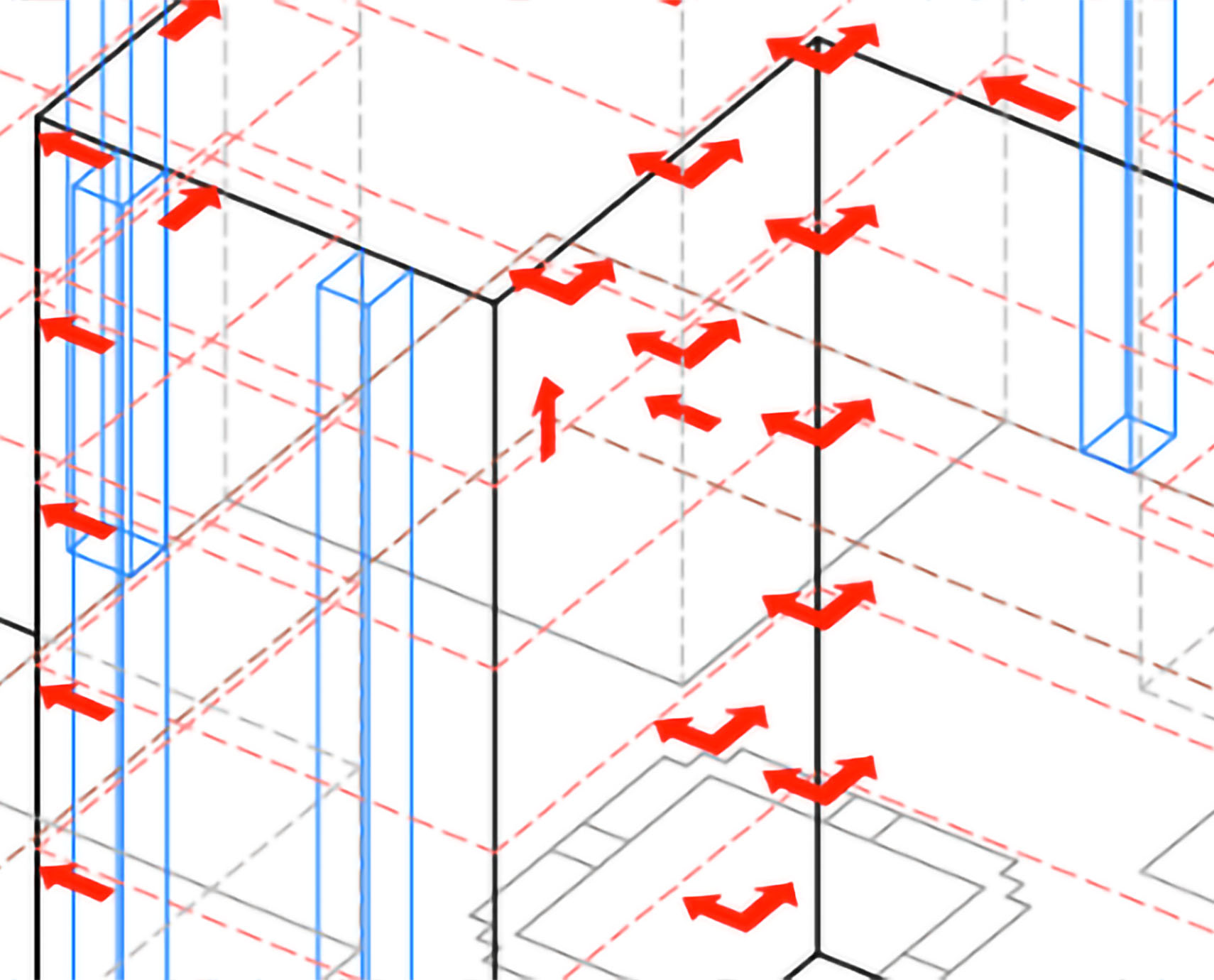
aOlder buildings that employ outdated construction methods are at greater seismic risk. (Image courtesy of NBBJ)
Is Your Building in Need of Seismic Retrofitting?
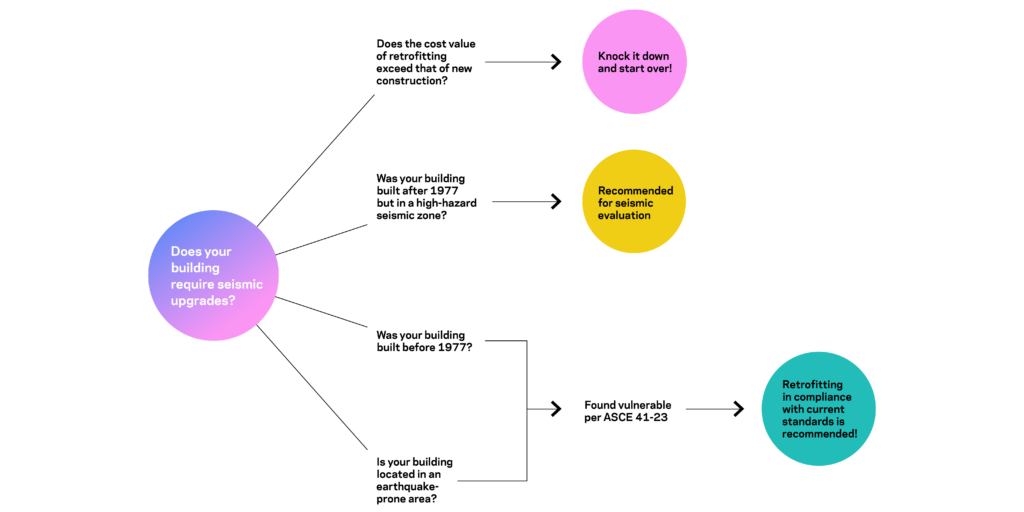
While seismic retrofitting is almost always a smart idea, determining whether your building needs to be retrofitted and, if so, where to start can be tricky. Fortunately, a simple set of questions can help you assess if your building requires seismic upgrades.
Simply put, it’s advised that buildings in earthquake-prone areas that were designed and built before benchmark building codes and standards for life safety are assessed for seismic retrofit. If the building is found to be vulnerable according to an ASCE 41-23, retrofitting in compliance with current standards is a recommended next step.
However, even if your building has not been found hazardous according to current regulations but was built before 1977 in a high-hazard seismic area, it may still be recommended for seismic evaluation. In California in particular, there are many mandatory seismic upgrade programs—for example, the required seismic retrofit ordinance in Los Angeles targeting soft story wood-framed structures and nonductile concrete buildings built pre-1980, Senate Bill 1953 mandating the seismic upgrade of acute care hospital buildings, and the UCOP Seismic Safety Policy addressing the inventory of existing University of California facilities. Standards and recommendations are also continuously updated based on new knowledge and technical advancements.
If a seismic retrofit is recommended, your organization can then determine the most pertinent actions for retrofitting. Some of these actions may include adding structural support, adding shear walls or steel bracings, using base isolation, reinforcing the foundation or using fiber-reinforced polymers. It’s also worth noting that retrofitting, while recommended in most cases, may not always be the right solution. If the cost value exceeds the cost of new construction, demoing and building new may be a better option.
This chart can help ascertain whether your building is recommended for seismic evaluation or upgrades. (Image courtesy of NBBJ)
Identify and Address Vulnerable Areas—Without Disrupting Operations
Though an important step in ensuring a building’s safety and longevity, seismic retrofitting can also disrupt a building’s daily operations as it often requires significant structural modifications to existing buildings. So, it’s important to think creatively about phasing and team coordination, as well as materials and processes.
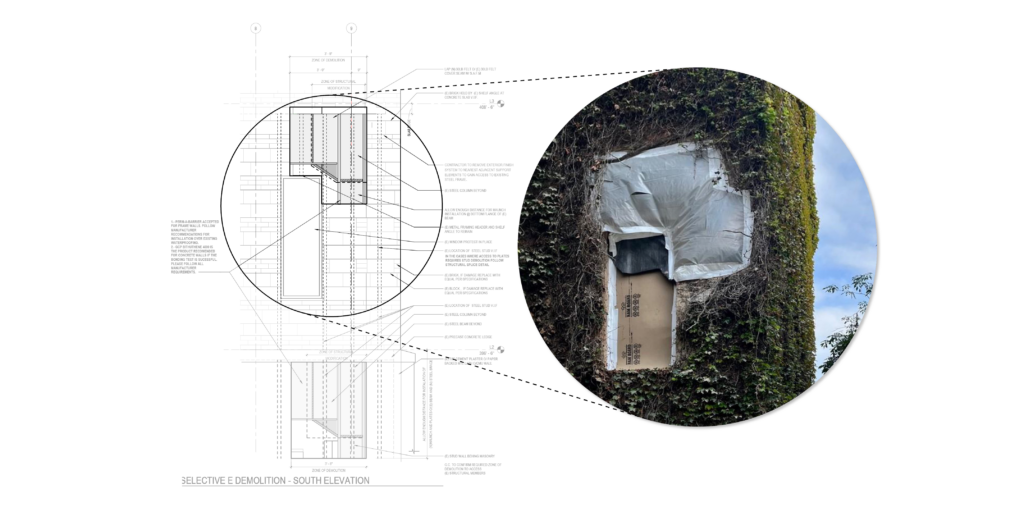
At UCLA’s Arthur Ashe Student Health and Wellness Center, selective demolition is used to strategically address seismic conditions. (Image courtesy of NBBJ)
For example, at UCLA’s Arthur Ashe Student Health and Wellness Center, the building’s pre-1994 steel moment frame—a lateral force-resisting featuring large entryways or openings—required targeted strengthening to improve its seismic resistance. A combination of structural reinforcement techniques such as bottom haunch retrofit details and reinforced diaphragm-to-roof connections allowed the team to address structural deficiencies, while phased construction and performing disruptive work during off hours minimized disruption to daily operations without the added cost of additional temporary structures to house users during the process.
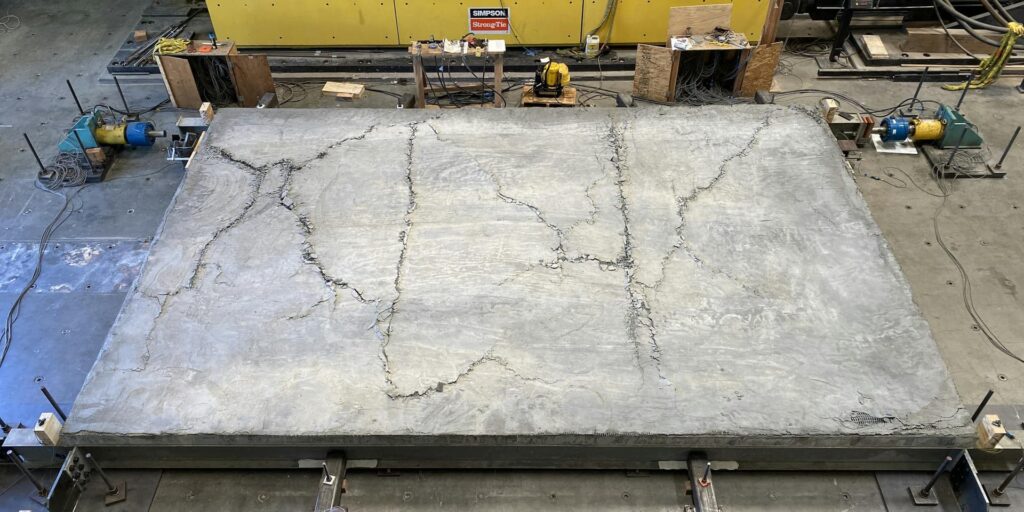
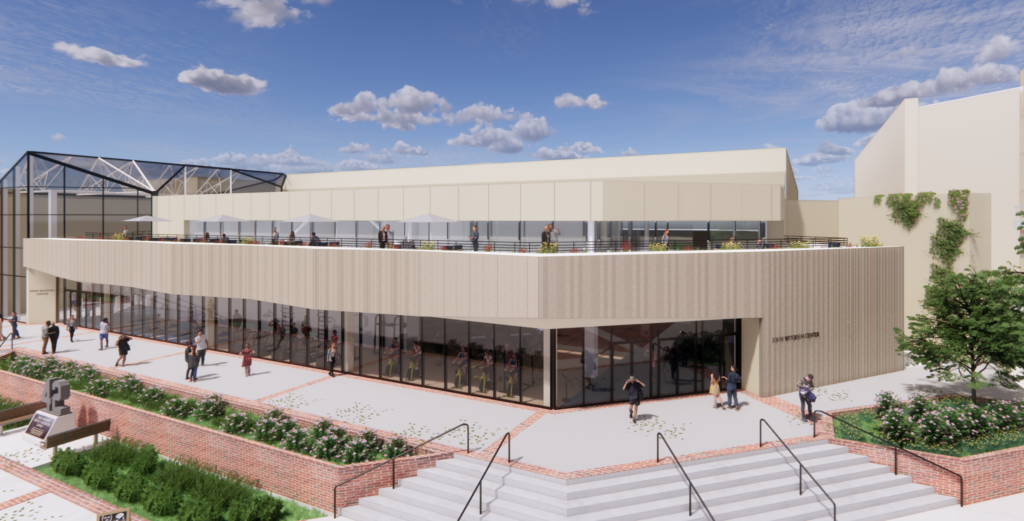
At the University of California Los Angeles’ (UCLA) John Wooden Center, a student recreation center constructed in the early 1980s, NBBJ and KPFF were tasked with strengthening the metal deck roof diaphragm—a flat, structural element used to transfer lateral loads such as those caused by wind or earthquakes to the vertical elements of a building. By employing Fabric-Reinforced Cementitious Matrix (FRCM), a material typically used for reinforcing concrete and masonry, the team was able to reinforce the roof from above, avoiding the need to access the underside which would have required extensive scaffolding and significantly disrupted the facility’s operations.
Testing of the Wooden Center’s roof indicates that employing FRCM on a horizontal matrix will be successful.
Improve Experience without Significantly Increasing Costs
Seismic retrofitting to address safety and legislative requirements—as described above—is often the most important priority. However, retrofitting can also provide opportunities for improved user experience without significantly increasing costs. And any additional costs incurred are often offset by the improved lifespan of the building and its systems.
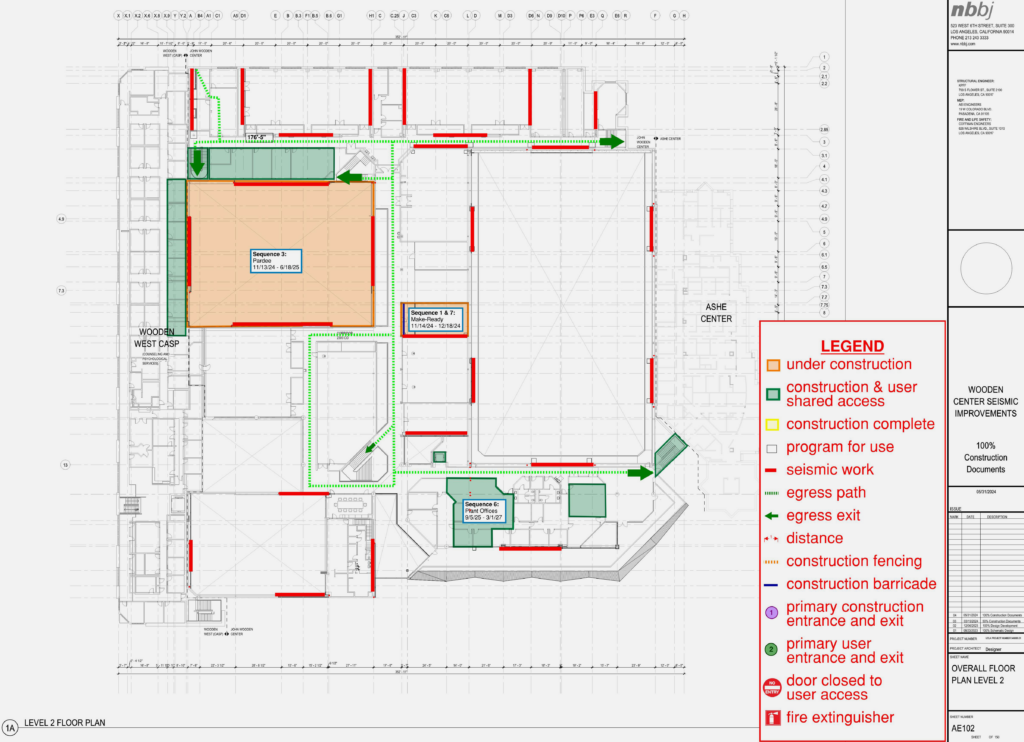
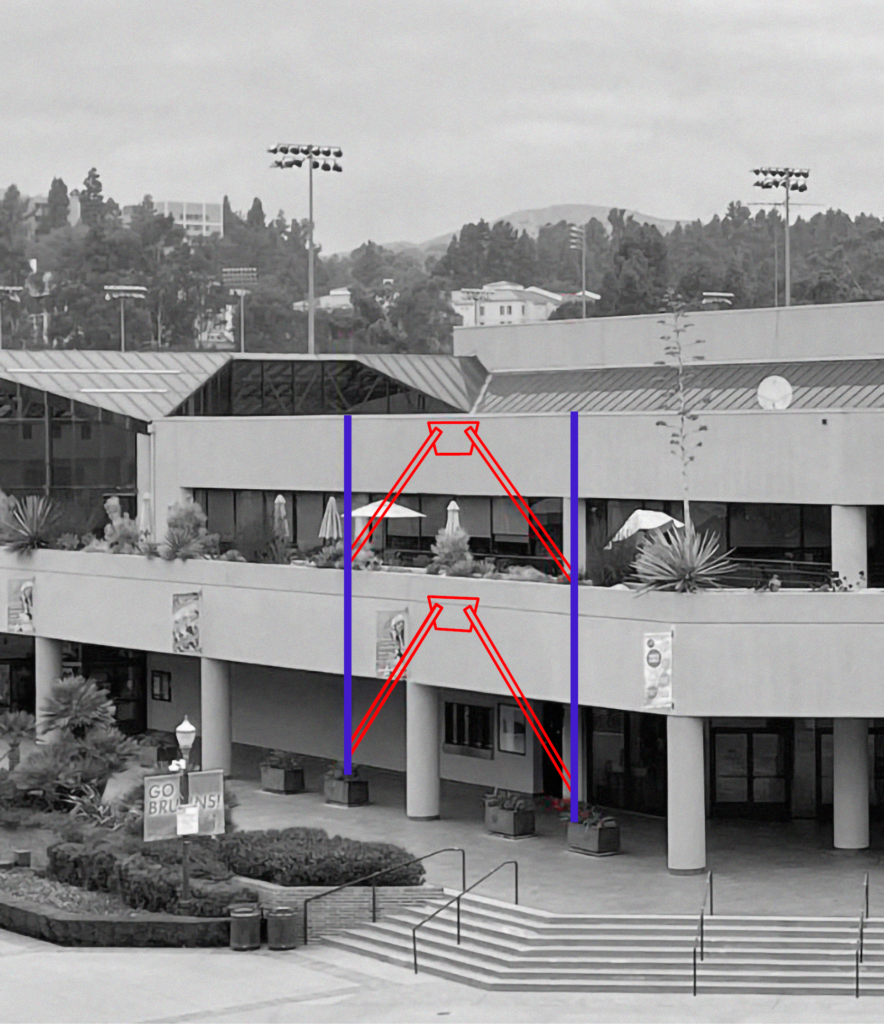
With an eye toward the 2028 Los Angeles Olympics and UCLA’s desire to position the building as a symbol of excellence, the team also engaged in a redesign of the Wooden Center’s existing interior and exterior spaces in parallel with the building’s seismic retrofit. An enclosed porch area between buildings now accommodates a variety of programs, attracting activity and fostering student involvement, while welcoming lounges create a comfortable atmosphere for students to relax and connect inside. The revamped exterior actively engages Bruin Plaza through shaded outdoor spaces and a more visible front entrance. By performing this work while the building was already under seismic construction, the team was able to reduce costs and construction timeline rather than embark on a separate, isolated project which would have been more expensive.
The design team used the required seismic upgrades at UCLA’s Wooden Center as an opportunity for building improvement with limited added cost and construction time. (Image courtesy of NBBJ)
Existing exterior and interior spaces were redesigned at the same time as the building’s seismic retrofit. (Image courtesy of NBBJ)
The loggia, or covered porch, will house a flexible space for classes and workout areas that is visually connected to the exterior and actively engages the Bruin walk and Bruin Plaza. (Image courtesy of NBBJ)
Seismic upgrades are complex yet essential for preserving lives and communities, regardless of building type. Retrofitting offers an opportunity to not only improve future safety, but to create beautiful, functional buildings at little to no added cost. What’s more, by focusing on innovative materials, efficient construction methods, collaborative design, and creative solutions, investing in pre-existing buildings can reduce waste and enhance building performance and lifespan.
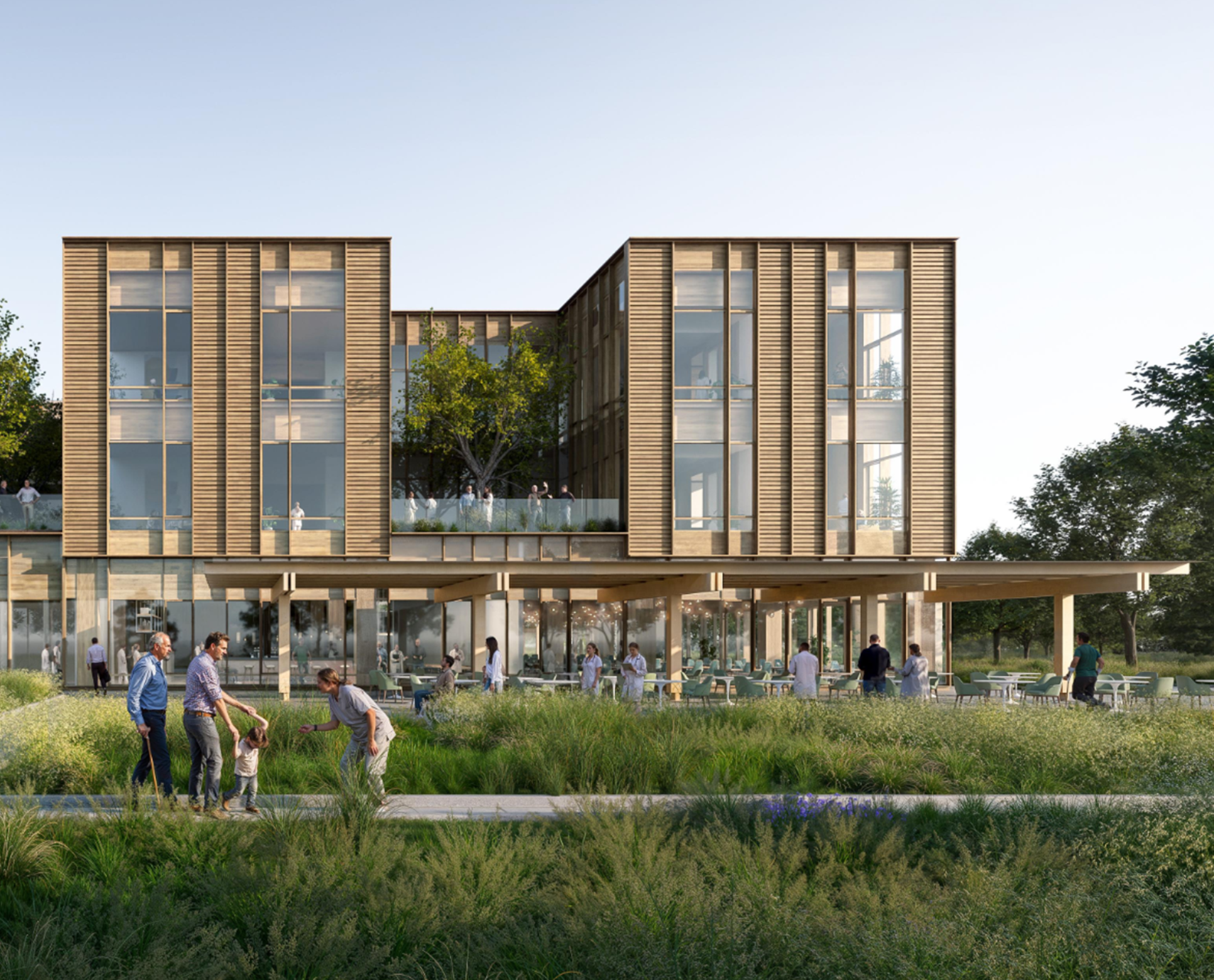
Though mass timber is consistently used as a design material for large-scale buildings such as offices, laboratories, and airports, it remains underutilized in the construction of healthcare facilities.
KPFF teamed up with ZGF and Swinerton in partnership with Timberlab, Degenkolb, Arup, University of Oregon Institute for Health in the Built Environment, PeaceHealth, Jensen Hughes, and Pierce McVey to perform an in-depth analysis on the potential use of mass timber in healthcare facilities. The comprehensive study sought solutions for adopting mass timber as a safe, efficient, and sustainable construction material in the healthcare sector.
The findings, published in “Mass Timber Hospitals: The Future of Healthcare,” clarify common misconceptions in hospital design such as hygiene control, lateral loads, acoustics, gravity systems, and framing.
Courtesy of ZGF
How healthcare facilities benefit from the use of mass timber:
Aesthetics & Hygiene: Not only is mass timber naturally hostile to microbes, but common wood-coating practices make it as easy to clean as traditional materials like steel and concrete. In addition, studies consistently show how indoor spaces that mimic natural environments contribute to an overall reduction in user stress—of special importance for healthcare settings with emergency rooms and 24-hour care.
Courtesy of ZGF
Sourcing: Sustainably-sourced timber benefits communities, forests, and rural or less represented parts of the timber supply chain. Prioritizing Climate Smart Forestry supports the proliferation of forests where more trees are grown than harvested. The timber’s journey from forest to built structure creates a unique opportunity for story that enhances a building’s community impact.
Cost Efficiency: The use of mass timber offsets overall cost at numerous stages of the design and construction processes. Assembly is faster, and interior finishes and foundation materials are less necessary for an aesthetically pleasing and efficient design.
Lower Carbon Footprint: A Life Cycle Analysis of a building’s full material lifespan shows that mass timber can reduce carbon emissions by 57% compared to steel structures. This lower carbon footprint is partially due to timber acting as a “carbon sink.” While manufacturing of materials like concrete typically releases excess C02 into the atmosphere, wood naturally stores atmospheric carbon before harvesting and, with proper care, continues to store carbon within the built environment, resulting in a lower overall carbon footprint per square foot.
Courtesy of ZGF
In addition to mapping the ways healthcare facilities benefit from mass timber design, the research study offers a deep dive into how each of the following elements can be adapted to meet the specific codes and requirements of hospital design:
Fire Protection & Code Compliance
Spans & Structural Grid
Gravity System & Framing
Vibration
Lateral Loads & Systems
MEPT Integration
Acoustics & Sound Isolation
Infection Control & Cleaning
Natural Ventilation & Daylight
Cladding & Enclosure
Embodied Carbon Analysis
Supply Chain & Wood Sourcing
Pre-fabrication & Modularity
Cost & Schedule
Insurance & Operations
As the need for carbon-efficient construction grows in the healthcare sector, KPFF continues exploring innovative mass timber design methods to help shape the future of healthcare facilities. For more information, you can download the complete research study report from the ZGF website at https://www.zgf.com/ideas/7295-mass-timber-hospital-the-future-of-healthcare.
Mass Timber Hospital: The Future of Healthcare” is a collaboration with ZGF Architects, Swinerton Builders, Timberlab, Degenkolb, Arup, University of Oregon Institute for Health in the Built Environment, PeaceHealth, KPFF, Jensen Hughes, and Pierce McVey.
A Consulting Engineer’s Guide to Due Diligence Reports
5 Keys to Success when Navigating Risk Associated with Due Diligence Reports
Don Oates and I, working with the KPFF Board and the KPFF President, comprise the Risk Management team for KPFF. We focus on risk management training and consulting with our KPFF partners about problems or opportunities related to professional risk on projects.
KPFF’s risk management philosophy is centered around six prescriptions for success:
Careful Risk Evaluation
Clear Scope of Work
Fair Contracts
Quality Work Product
Adequate Construction Phase Services
Effective Communication
Steve Litchfield, managing partner at Litchfield Malone McDonald, has served as KPFF’s outside general counsel for several years. Recently, Don and I have been speaking with Steve about due diligence reports through the lens of our risk management strategy. Steve compiled his thoughts, with some input from us, into an article titled “A Consulting Engineer’s Guide to Due Diligence Reports,” linked below. In this article, Steve discusses risk associated with due diligence reports and five keys to success when navigating these projects.
Buildings are an essential part of our daily lives – we sleep in them, work in them, eat in them. But how do the buildings we live in impact the world around us? From unprocessed materials to initial construction to daily operations to eventual decommissioning, every phase of a building’s life produces environmental impacts. Life Cycle Assessment (LCA) is a modern tool for illuminating these impacts and making choices in design that will lead to a more sustainable and resilient structure.
What is a Life Cycle Assessment?
Life Cycle Assessment is a method for quantifying the environmental impacts of a product or process across its entire existence. Coca-Cola performed the first Life Cycle Assessment in the 1960s to evaluate the environmental impacts of its glass bottles, encompassing material extraction, transportation, product use, and disposal. Since then, Life Cycle Assessments have crossed sectors to influence buildings, not just bottles.
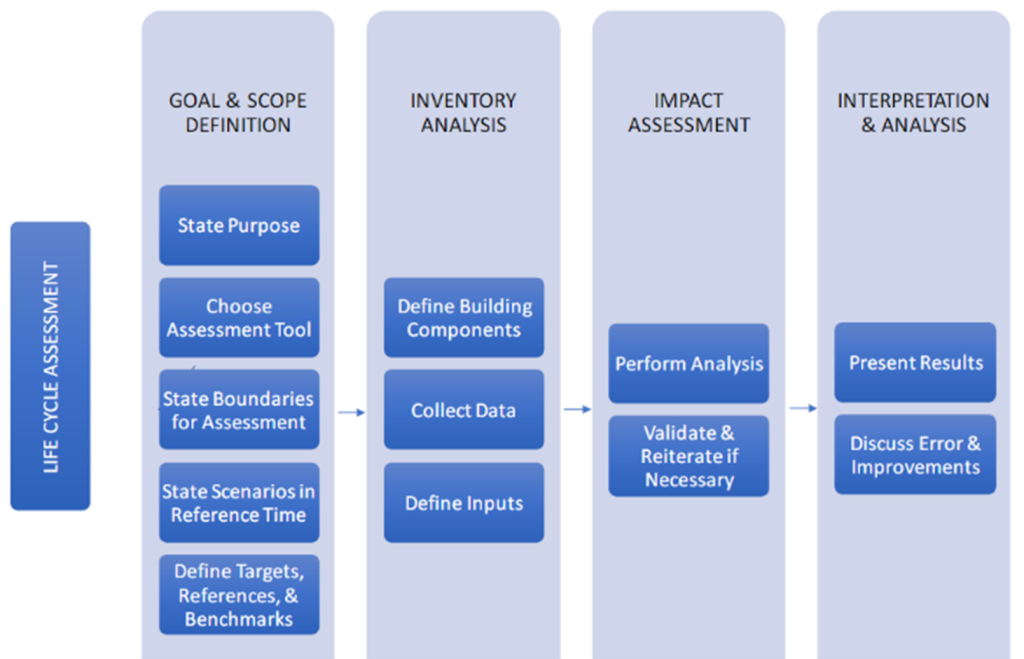
In the architecture, engineering, and construction industry, the LCA process involves four stages: (1) goal and scope definition, (2) inventory analysis, (3) impact assessment, and (4) interpretation and analysis.
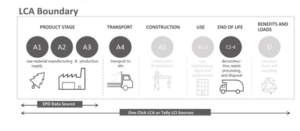
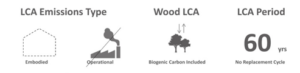
The most widely used metric in Life Cycle Assessments for buildings is global warming potential (i.e., the CO2 equivalent released into the atmosphere as a result of the building project). It is often abbreviated as GWP. Other metrics in LCAs include acidification, eutrophication, ozone depletion, and smog formation potentials. Products such as Tally, Athena, and One Click make performing an LCA more manageable by maintaining life cycle inventories of products and, in some cases, integrating with modeling programs (e.g., REVIT). The assessment evaluates raw material extraction, processing of raw materials into construction products, transportation to the site, building use, deconstruction, and material disposal or recycling/reuse.
Why Perform a Life Cycle Assessment?
A Life Cycle Assessment performed early in a building’s design can help:
Inform Structural System and Building Materials Selection. The environmental impact of studied systems and materials are quantitatively provided by LCA. This can, in turn, provide confidence to designers and owners as they optimize design and assess the merits of each system or material. Furthermore, prioritizing low environmental impacts is an emerging trend, leading to advancement and innovation within the AEC community.
Achieve Sustainability Certification. Performing a Life Cycle Assessment can earn points toward LEED certification, International Living Future Institute certification, or other green building initiatives. For building owners who value sustainability certification, particularly where global warming potential is a criterion, an LCA is essential.
Identify Opportunities for Improvement or Efficiencies. Explicit consideration of environmental impacts has led to innovative building systems and methods. The rise in construction of mass timber buildings has grown synergistically with the rise in acknowledgement of the global warming potential contributed by building construction. Similarly, the development of low-carbon concrete technologies has rapidly expanded in response to concerns expressed by design teams over the contribution to global warming potential from Ordinary Portland Cement. An LCA provides the critical opportunity to better understand a project’s sustainability impact and thereby explicitly target the use of innovative solutions.
Utah Case Study
For a recent multifamily development in Utah, the owner wanted to compare costs and benefits between an all-steel structural system and a steel-timber hybrid system.
KPFF performed a high-level Life Cycle Assessment, focusing on embodied carbon (or global warming potential) and embodied energy (or energy depletion potential). The study found that the global warming potential and energy depletion potentials were approximately 70% and 50% lower, respectively, in the hybrid structural system when compared with the all-steel system. The decreased environmental impacts were due to the significant amount of carbon sequestered within lumber products (known as biogenic carbon) and the low energy associated with producing mass timber products.
Additionally, KPFF explicitly considered the architectural floor assembly within an improved LCA study. The floor assemblies in the study were unique because the project was targeting high sound transmission class ratings. Including the floor assembly, which varied between structural systems, allowed a more wholistic analysis to be conducted. When including both architectural floor assembly and structural system, the study found that the global warming potential and energy depletion potential were approximately 10% and 30% lower for the hybrid system when compared with the all-steel system. These results, when compared to the structural system only results, reflect the importance of a wholistic approach to LCA. These rapid LCAs took less than a week to return to the owner and provided them with critical, quantitative information on the environmental impacts to consider along with cost and other factors.
Regardless of project type or size, a Life Cycle Assessment is a valuable tool for evaluating the impact of buildings throughout their lifespan. By informing design decisions, Life Cycle Assessments can help owners and design teams select appropriate building materials, achieve project sustainability goals, and identify opportunities for innovation. As the construction industry continues to prioritize sustainability, Life Cycle Assessments will become increasingly important for designing and constructing buildings that not only give us spaces to live, work, and play, but preserve our planet for decades to come.
To learn more about KPFF’s commitment to sustainability and environmental stewardship, click here.
[Cover Image: Julia West Apartments; rendering courtesy of Holst Architecture]
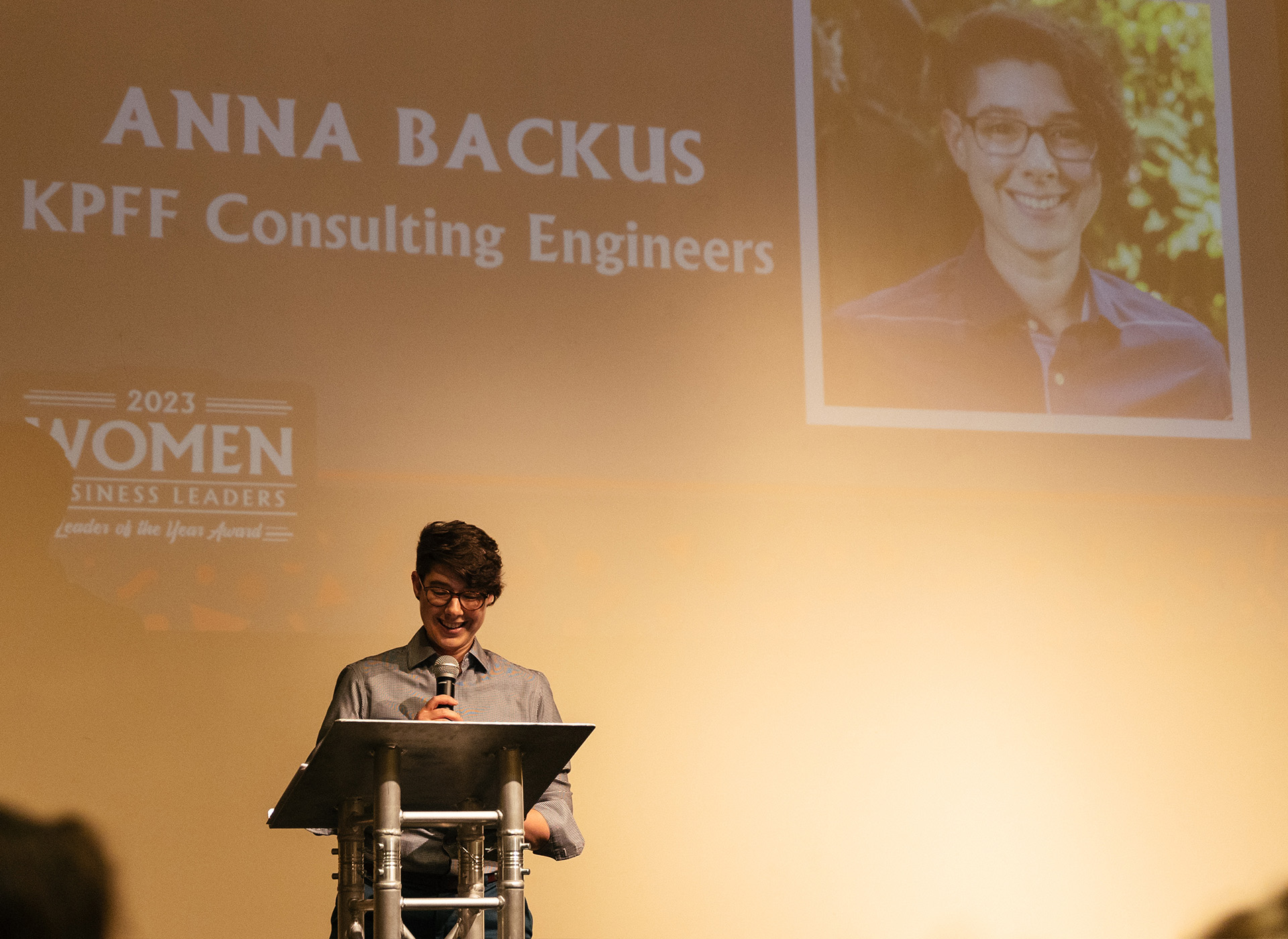
On Thursday, April 6th, I attended a full-day RISE Leadership Summit with GiANT hosted by the Eugene Chamber of Commerce. I am happy to report I did leave the day with some new tools and new inspiring contacts. The cherry on top was being honored at the afternoon reception as one of 4 Leaders of the Year finalists.
As I sat with my wife and fellow nominees from different Eugene companies, I was humbled and grateful to be recognized among them. With 15 years as a civil engineer and project manager, my career is evolving to that of a group leader, manager, and mentor (while also engineering and managing projects). I’m constantly learning, but I know that leadership takes knowing yourself, listening more than talking, applying your unique strengths, and constantly recalibrating to your team’s needs and dynamics.
The Downtown Athletic Club ballroom was filled. My whole office was in attendance. My panic about public speaking was turned up to 11. After some introductions, a video played featuring Matt Keenan, a man who proved his wisdom by hiring me when I was a totally green engineer, and has been my manager, mentor, colleague, and friend over the years. He said I made him a better person and all kinds of other nice things that I hope to live up to.
Then I had the mic to address the crowd with my prepared speech. And here it is:
Hi, I’m Anna Backus, and I’m a civil engineer, project manager, and group leader at KPFF Consulting Engineers. I’d first like to express my gratitude. Thanks to the Eugene Chamber for putting this event together, and to Matt Keenan for nominating me. I really appreciate your thoughtfulness in doing so. I am very grateful to be up here and in the company of these amazing women.Like I mentioned, I’m a civil engineer, and when I’m describing my job I’ll often say that if I’m doing it right, you don’t notice. If I do my job right, the built world just works. The tap works when you turn it on, you can safely and easily navigate the streets, you can use pedestrian areas and access buildings whether or not you’re able bodied, and, of course, you never encounter a puddle.So while I hope you have not noticed my hand in design, I think you will be familiar with our projects. Matt opened the office in 2004 to work on Riverbend Hospital, and since then, we’ve done a number of schools including North, Edison, and Jefferson, parks, including the recently completed Riverfront Park, various University projects including Knight Campus and the new dorms, and housing of all kinds, but closest to my heart, affordable housing including most recently The Nel on 11th and Charnelton. I’m proud of the work we do in Eugene, and I feel very lucky that answering a Craigslist job posting in 2008 led me to a company that believes you find success by following your passion, puts an emphasis on sustainability, and always looks for the best solution instead of just the usual one. I have had all the supportive leadership and resources to grow that someone could hope for, but sometime deep into the couple years of forced introspection that Covid brought, I realized that I had never worked for a woman in my career as an engineer. I want to be clear that there are women in all levels of leadership at KPFF, but we are a rare enough breed that through happenstance or bad luck, I had never had the opportunity to work for them. I resolved in that moment that I would be the last generation that could say that. I made it my goal to make sure that we not only did the easy part and hired women and BiPOC folks, but also created a culture where they are comfortable and can thrive. My desire to see underrepresented communities succeed at KPFF made me push to be the group leader in Eugene when the job became available.Now, as you know, I’m an engineer, but I’m also a Midwesterner, so open communication does not come naturally to me. So thank God I landed in Eugene. I’ve learned so much from design and construction community here. For the past 15 years, I’ve been able to observe and then participate in discussions with many different viewpoints… always with the goal to make Eugene better. What I’ve seen in those discussions is that being open and straightforward results in the best outcomes. Hearing and respecting everyone’s opinions is the best way to move toward a solution. And, it is clear both that Eugene fosters this type of communication and that it’s far from a universal approach outside of this community.I was able to take these lessons and use them as a manager. I try to make sure that communication is open and honest, and I approach problems with the assumption that everyone has good intentions and the same goal. In my work life, I honestly did not think I could like anything more than spreadsheets, but leading my team has been the most enjoyable and rewarding thing I’ve done in my career.To my team: you guys are awesome. We have an office that is collaborative, diverse, and productive. You bolster each other up with your strengths, and don’t hesitate to ask for help when you need it. And our culture is all you: you bring the open communication, the inventive spirit, and the fun. It is such an honor to work with you, and I can’t wait to see the leaders that you’ll become.
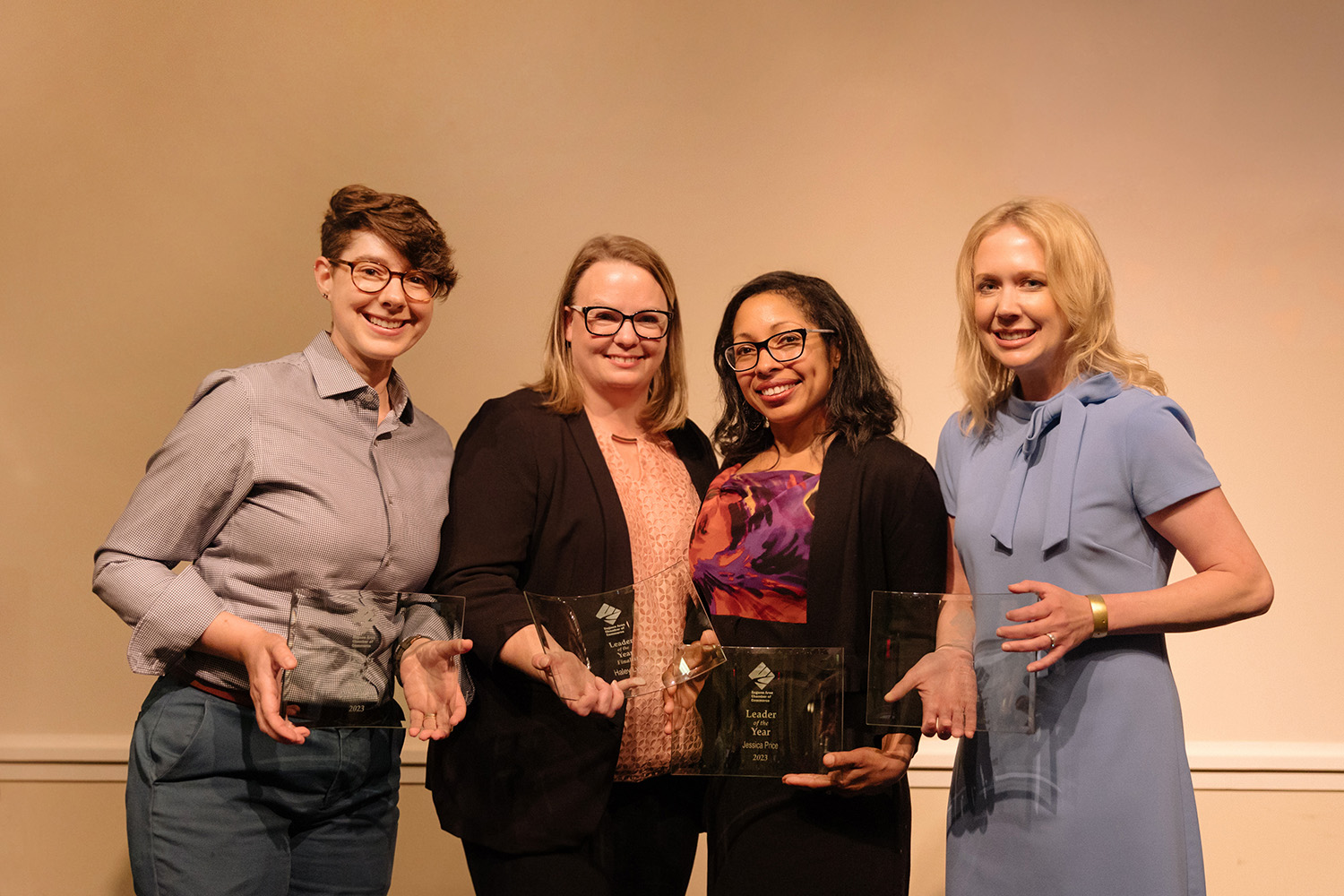
Left to Right: Anna Backus, KPFF, Haley Lyons, Kernutt Stoke, Jessica Price, University of Oregon, Jenny Bennett, Summit Bank (Photo Credit: Delene & Co.)
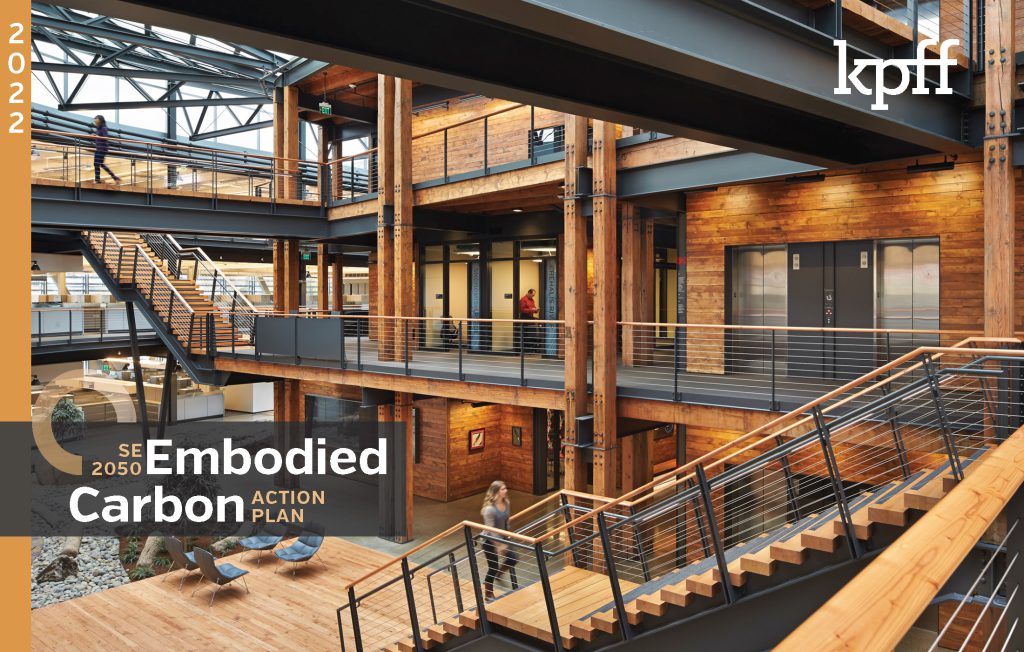
As we move towards updating our Embodied Carbon Action Plan (ECAP) for 2023, we’d like to highlight some of the moves we have made and work we have done to push the SE 2050 initiative forward.
2023 ICM Conference on Translating Climate Ambition into Climate Action
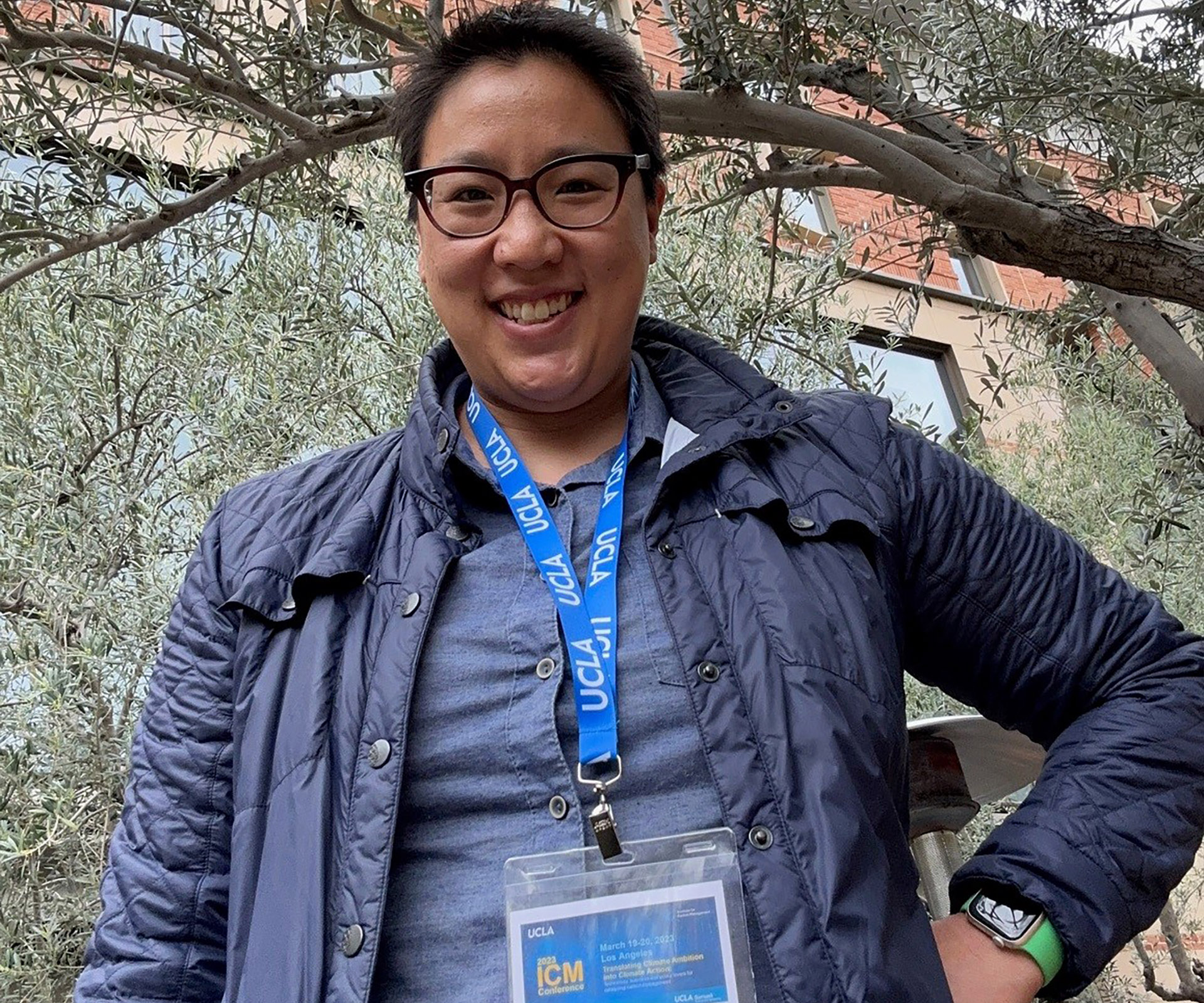
KPFF was honored to be invited to the 2023 Institute for Carbon Management (ICM) Conference on Translating Climate Ambition into Climate Action. Molly Seto, KPFF SF (pictured at left) and Kane Pithey, KPFF Los Angeles represented KPFF at the conference at UCLA. It was inspiring to hear about the great work that Professor Gaurav Sant and team are doing at ICM. We were able to connect with some of the relevant climate tech businesses that have spun out of ICM and discussed how we can collaborate. The conference also highlighted different voices regarding climate action, and it was very informative to hear how investors think and fund new climate technologies as well as discussing the challenges of scaling. We’re excited to see the progress and direction we’re taking as an industry and we at KPFF are doing our part to move the needle towards net zero embodied carbon in our designs.
KPFF’s 2022 SE 2050 ECAP
Partnering with Clients to Educate and Find Environmentally Responsible Solutions
With all the environmental concerns we’re facing, it’s important for architects and engineers to work together to come up with sustainable building solutions that reduce carbon emissions and energy waste. By working together, we can combine our unique expertise to create sustainable, cost-effective, and efficient buildings while reducing the overall carbon footprint of the built environment.
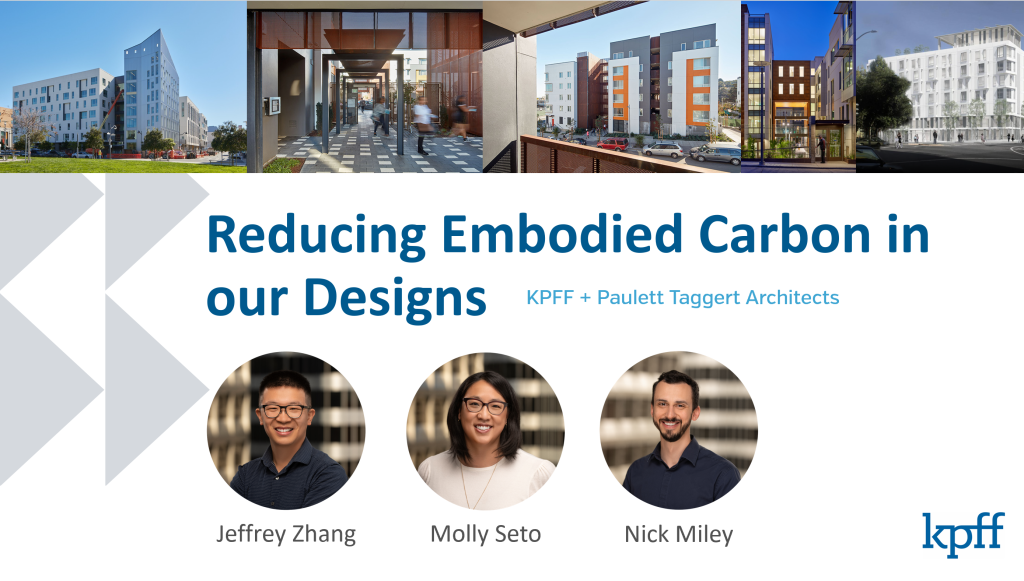
Paulett Taggart Architects (PTA) has been a close partner with KPFF on affordable housing projects in the San Francisco Bay Area. Affordable housing projects should not only serve our underserved communities but also be sustainable as climate change disproportionately affects these same communities. We presented at PTA’s office on how we could reduce the embodied carbon in our designs together. We discussed our SE2050 Commitment how to quantify embodied carbon using programs like Tally and excel and reduction strategies aimed specifically for affordable housing. We had a great time hanging out with our colleagues at PTA and so did they!
The team gave us an instructive, accessible, and encouraging introduction to embodied carbon analysis terms and methods. The presentation offered great insight into KPFF’s embodied carbon reduction efforts, and the discussion helped me see opportunities for coordination between our teams to further reduce the carbon footprint of our projects. –Lily Oyler, Designer
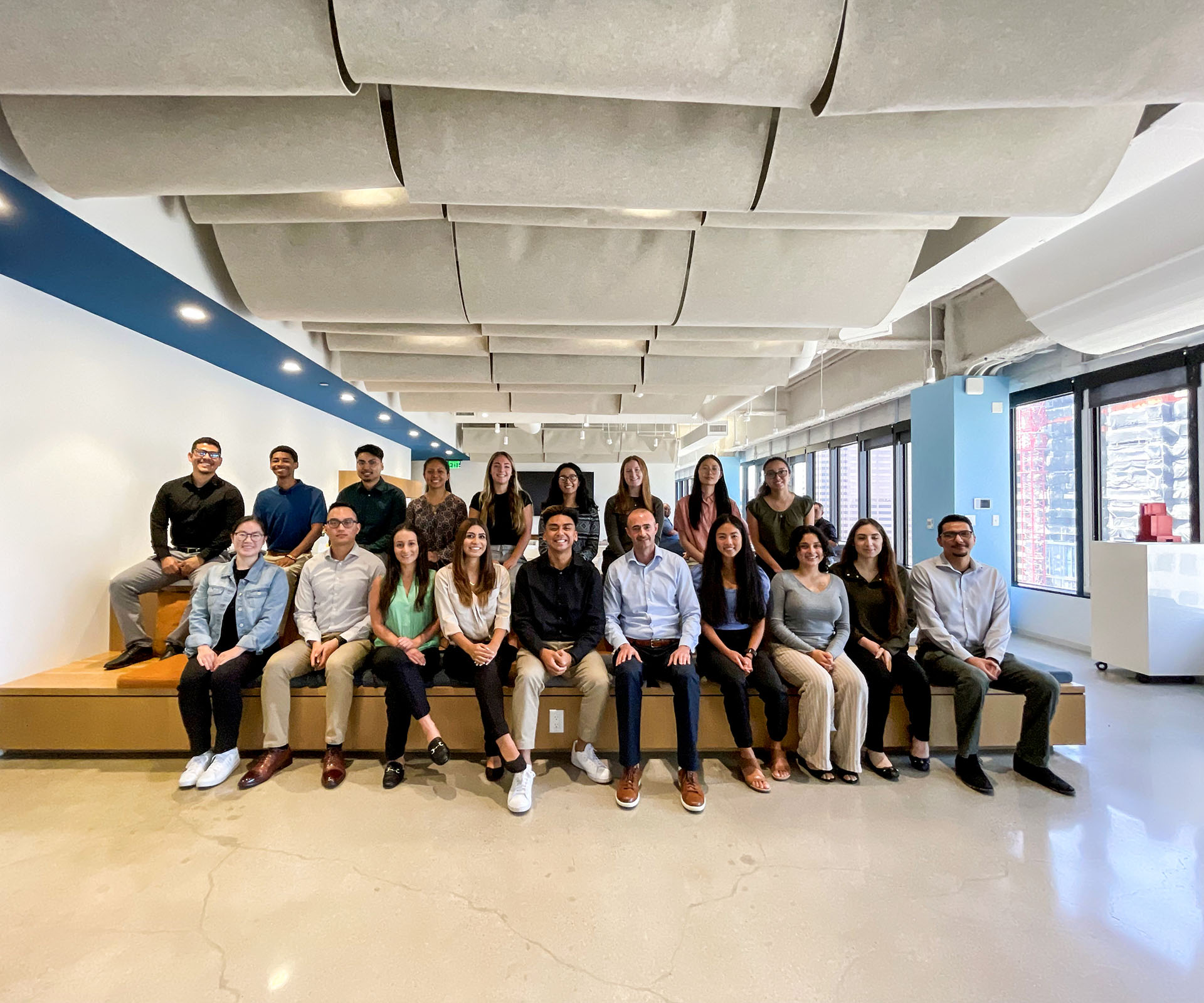
As we do every summer, KPFF LA Structural welcomed our 2022 Summer Intern class to explore the world of structural engineering and experience our interactive office culture. This summer, we have twenty interns. While the stereotypical tasks of an intern may include getting coffee, moving boxes, and making copies all day, this didn’t fit into KPFF LAS’ long-term vision or mission. We want our interns to feel they’ve had a productive summer – learning skills on the job to help their academics and beyond.
During the first week of their internship, interns are assigned to an engineering team and a live KPFF project. To bring the Interns up to speed and provide them with the skills needed to contribute to these projects successfully, we created a comprehensive training program. By giving Interns these skills early in the program and connecting them with engineers at all levels, the interns can jump into projects immediately and experience what it is to be a structural engineer.
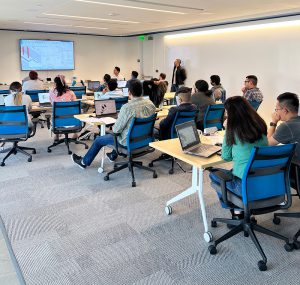
When I asked staff to gauge interest in leading the seminars, I was AMAZED how easy it was to find eager volunteers. We had 47 volunteers to conduct training sessions – 26 veteran trainers and 21 new trainers for the Crash Course series! The trainers range in experience from new engineers to 25-year engineering veterans.
This enthusiasm exemplifies our “Forefront” philosophy. Forefront, our education philosophy, provides a supportive and positive environment to make it happen. The forefront experience starts the day you walk in the door at KPFF and continues as a career-long effort to help us all advance and grow together. Engineers at all levels bring something to the table and can be resources to their colleagues.
Putting together a training series or revamping one from previous years is no easy task. Trainers met weekly for several months to create outlines, models, reference guides, practice examples, and PowerPoint slides; and then performed dry runs of the material before the first training session. Although our office was busy overall, the level of effort and attention to detail in this training was unparalleled.
At the beginning of this calendar year, when discussing how to improve our intern training program, we met with the Team Leaders since they are the ones who train the Interns and assign the engineering tasks. We incorporated the feedback into our 2022 Intern Training Program, which features the following components:
ENTRY LEVEL CRASH COURSES
Entry Level Crash Courses are a new addition to the 2022 training schedule, intended for new engineers and interns coming right out of school. Ideally taken during the first week of employment or their internship, these practical trainings include elements of structural engineering design. The Interns and new hires are brought up to speed faster and can jump in on projects more confidentially.
We intentionally recruited junior trainers for the Crash Courses – they are closer to the actual numbers, spreadsheets, etc., and can offer more recent lessons learned than some of the more senior engineers. Additionally, most of the junior engineers are naturally younger, and we felt they would be more approachable as another resource in the office the Interns could refer to for questions.
ENTRY LEVEL SEMINARS
Upon completion of the Crash Courses, the Interns attend the Entry Level Seminars, which are provided for all new KPFF LA Structural Engineers. These Seminars cover structural engineering topics in more depth and offer insight on professional development at KPFF, relationship intelligence, and other aspects of the Architecture, Engineering, and Construction (AEC) industry.
INTERN DESIGN PROJECT
We provide our Interns with hands-on experience on real-life KPFF LA projects, but since we only have them for 8-12 weeks, they will not see the project through completion. The Intern Design project gives interns experience on every project level – from concept through completion – on an accelerated schedule to fit within the summer program.
Our Intern Design Project changes each year and is based on a completed KPFF LAS project. The Interns are tasked with developing an ETABS model, analyzing the building and proposing a retrofit scheme, and then presenting their project to their team at the end of their internship. Interns are provided with weekly training sessions and an assigned liaison for support.
Structural engineering is about continuous learning and then learning some more! We hope out interns feel like they made strides in their professional development while enjoying themselves during their time at KPFF. If not, we hope they take the opportunity during their exit interviews to provide honest feedback so we can improve our program for next year’s interns!
“I Was Made For This” – Celebrating International Women in Engineering Day 2022
I was made for this.
I don’t mean that I was born for this. Some people have this sense of destiny or fate, or they just really know what they want to do when they “grow up.” They just seem to know what they want to do (insert shrug here). Not so with me: it took me a while to figure “me” out – to make me.
As I look back on that process of making me who I am now, the most impactful, life-changing moments were the most subtle.
EDUCATION
I grew up with little means but with well-resourced schools and teachers who recognized a kid with an insatiable appetite for learning. After school, my dad would take my sister and I to the library where we devoured as many books as we could get our hands on. I didn’t discriminate; I read Reader’s Digest, To Kill a Mockingbird, books on entomology, and the backs of cereal boxes. The more I learned, the more I wanted to learn, the more possibilities there were. I remember filling out college applications thinking, “How am I supposed to choose just one thing to study?” Engineering seemed like the best way of taking what I enjoyed (math, physics, and art history) while allowing myself to be useful. I chose to study structural engineering.
Engineering seemed like the best way of taking what I enjoyed (math, physics, and art history) while allowing myself to be useful.
TRAINING
At KPFF, I have been blessed with generous teachers and mentors. I learned not only the technical aspects of structural engineering, but also how to plan, how to deal with stressful situations, how to use conflict to reach resolution, how to dialog. This work often feels hard because it is hard. But I have been trained to do hard things, and I can face them with both courage and creativity – this is what I hope to pass on to others I am training. I choose to do hard things.
LOVE
It’s not what I was looking for when we met, but I cannot stress enough how important my partner has been to my career. I found a real partner in life, someone who celebrates my choices and supports my effort and ambition. Though I feel blessed, I don’t feel lucky. I don’t think of love as being discovered, fated, or completely up to chance. I think of love as a choice and a habit. I choose to love him, and I choose to love my work.
MOTHERHOOD
I appreciate my parents much more now that I have children of my own – my parents had almost sainted levels of patience to have kept their cool as much as they did! Even so, I know my path to and through motherhood is more comfortable than my mother’s was and her mother’s was before her. My mother didn’t have a choice but to work, and she didn’t have many options on what her work would be (she stopped going to school at age eight). By contrast, I know the time I take away from my children and partner has to be meaningful enough to warrant the opportunity cost. My work as an engineer adds to society and saves lives. I choose to be a working mother.
I am proud of the work I do and the person I am. My life made me for this. My work made me for this. I made me for this.
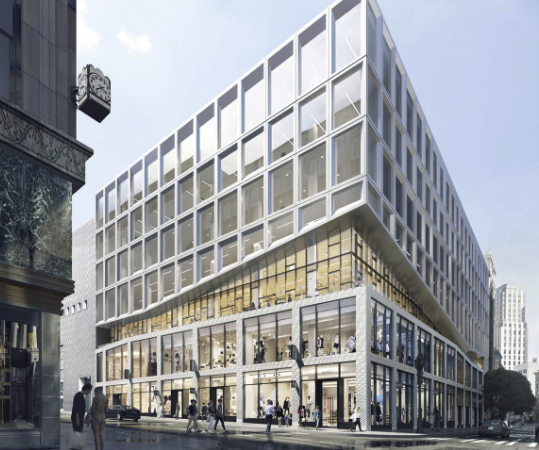
Standing seven stories tall, with a Brutalist aesthetic and an aging facade, 100 Stockton in San Francisco (or Macy’s Mens) was originally designed for a single retail tenant in the early 1970s in a time when solid walls were acceptable and natural light was sometimes an afterthought. Rather than tear down this historic structure the developers tasked the design team with transforming this introverted, dated building into an extroverted, light-filled jewelbox.
The overall project vision is to reshape 100 Stockton into a mix of retail and office space as well as add a rooftop restaurant and a wrapped outdoor terrace at the third floor. The engineering systems play a large role in this vision, so Lead Architect, Gensler collaborated with KPFF to explore options for both the site and building civil engineering and the complex structural systems required to give this Union Square icon a new life.
The work not only changed the building’s appearance and functionality but elevated the skills and confidence of several budding engineers.
Our structural team rapidly assessed over forty possible schemes, including interior cores and exoskeletons of various configurations. Creating this rapid response team during conceptual design encouraged creative solutions and ensured that the path taken throughout design was one that delivered a renovation and retrofit consistent with the developer’s expectations.
Associate and Structural Engineer Nick Miley shared “working on 100 Stockton was a whirlwind at first. Our team had to respond to new tenant layouts and client feedback while evaluating a complex tangle of structural constraints. I was one of four engineers tackling the analysis challenge. We learned to work collaboratively and build on each other’s ideas – no idea was too crazy to be considered. This process taught me how to think about design options with the client’s objectives in mind and the importance of letting go of my preferred option in favor of new ideas that benefit everyone. Working on this project from design through construction has been a challenging but extremely rewarding experience that has shaped the trajectory of my career.”
KPFF Civil Engineers modernized the stormwater management and added a new rainwater reuse system, to help achieve LEED platinum certification. Replacing the sidewalks renews the relationship of bustling pedestrian traffic and store entrances while complying with ADA standards. In addition, they negotiated systems design with new infrastructure for the Muni underground light rail extension adjacent to the basement level.
“Being located close to our client and design team members allowed us to interact quickly and easily. Whether it was reacting to unforeseen conditions or coordinating with a massive and on-going public infrastructure project, we were able to develop solutions in a timely manner to keep the design and construction process moving. The time spent together early has built a level of trust and understanding that has grown throughout the project.” Ryan Beaton, PE, Associate, Civil Engineer
During Construction (sky due to 2019 fires)
To increase seismic resiliency, add and enlarge windows, and create more open floorplates – multiple, complimentary structural solutions were designed. These solutions included:
an entirely new lateral system in the core of the building, including new walls with large openings at the lower levels for tenant flexibility and transitioning to buckling restrained braces (BRB’s) to allow for clear views on the office floors
installation of perimeter beams and columns to remove thick perimeter concrete bearing walls and to create a seismic separation from the adjacent buildings
carbon fiber wrapped gravity columns to provide ductility and mitigate earthquake damage
removal of two levels and adding supportive steel framing, with replacement of the concrete-framed ground floor with stepped steel framing to accommodate multiple retail tenants
replacement of the roof framing with steel framing to support the new restaurant space and landscaping
curtain wall clad with terra cotta tiles to match the surrounding buildings
removal of several existing columns and modification of the existing post tensioned girders, which required shoring the entire building at every level
a horizontal steel truss cantilevering off the newly poured columns
A project this complicated has a list of unknown conditions and lessons learned too numerous to mention. One of the keys to the team’s success was to avoid the standard “problem finding”mentality in favor of a solutions-based, collaborative mindset.