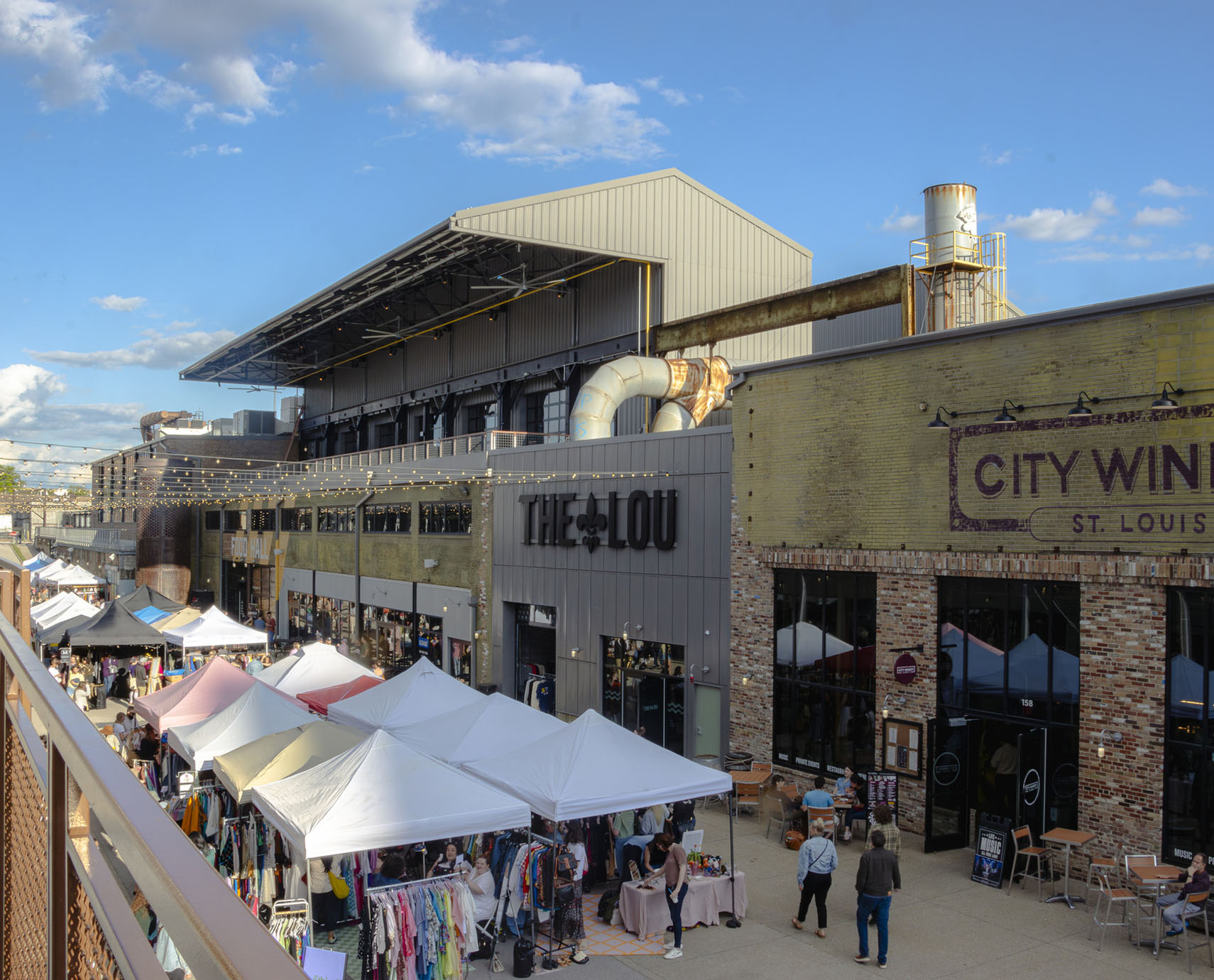
Walk through City Foundry STL on any given afternoon and the place is busy—food hall crowds, shoppers walking between retailers, and preserved pieces of the old foundry echoing the site’s history.
It’s hard to imagine that, not long ago, this 15-acre site was vacant and slated for demolition.
Century Electric had once been one of St. Louis's "big three" electrical manufacturers, building motors to power everything from home appliances to factories. Their foundry, built in 1929, was among the largest job shop operations in the Midwest and continued operating until 2007. The site sat vacant for nearly a decade with years of disuse taking a toll before Lawrence Group and the development team brought in a vision of redevelopment.
Lawrence Group’s vision was ambitious: a mixed-use destination combining a food hall, retail, office space, structured parking, and public connections to the surrounding neighborhood. Delivering that vision meant navigating a site full of unknowns above and below ground.
Understanding the Site
Before design could move forward, the team had to understand what was happening beneath the surface.
Geotechnical conditions varied dramatically across the site. Bedrock was shallow in some areas and dropped off steeply in others, sometimes within short distances. A single foundation strategy wouldn’t work.
"A challenge for this project was the varying geotechnical bearing condition on the site,” says Bob Daugherty, Principal at KPFF. “The bearing rock was shallow at several locations, but at others it did dive deep. We worked with the geotechnical engineers and contractors to come up with solutions that took advantage of those differing conditions."
Rather than forcing a one-size-fits-all approach, the team adapted the structural system to match the conditions at each location, using a mix of deep foundations, shallow foundations, and soil remediation. The result was a flexible strategy that reduced risk while keeping the project moving.
That flexibility proved critical as construction progressed. During excavation for new retail buildings, poor soil conditions were discovered beneath the footprint of the new retail buildings. Addressing the issue required soil remediation and redesigning new foundations to accommodate the unforeseen conditions — an intricate solution that had to be executed without disrupting the project schedule.
"When excavation began, we discovered poor soil conditions,” says Tim Rowbottom, Principal and COO of Lawrence Group. “KPFF was an amazing partner on that project, helping us with extremely intricate, detailed foundation designs."
Constraints extended beyond the site itself. Construction along Forsyth Boulevard required temporary shoring and tiebacks beneath an active city street. Those elements had to be removed once the permanent structure was complete. Sequencing that work safely, while maintaining progress, required close coordination between the design team, contractors, and the City.
Working Within (and Between) Structures
City Foundry isn’t a single building—it’s a collection of new and existing structures tied together across the site.
KPFF’s work spanned new mixed-use buildings, a multi-level parking garage, and the renovation of historic structures. Each came with its own constraints, but the real complexity was in how they connected.
"All of these buildings were very close together, and many of them were tied together with pedestrian bridges,” says Tyler Bick, Project Engineer at KPFF. “There’s quite a bit of coordination just between buildings to get everything to align and work together."
That coordination extended to the renovation of the historic Byco building, where a new grocery tenant introduced modern operational needs into an existing structure. Creating adequate loading access required removing a structural column. “Taking a column out of the loading dock area was a big challenge,” says Daugherty. “We had to re-support the roof structure and give adequate space for tractor trailers to back in and deliver goods.”
Historic renovation differs from new construction in a fundamental way: the structure defines the limits. Solutions have to work within those boundaries, not around them.
Structure as Part of the Design
The new buildings introduced a different kind of challenge. The architectural vision called for exposed structural steel, making the structure itself part of the aesthetic.
“The architect wanted an industrial-looking building,” says Bick. “A lot of the steel was exposed, and we had to be careful with how it looked from underneath.” KPFF worked with the design team to balance what was needed structurally with what they were trying to achieve visually. “That was a fun thing to work out with the architect,” Bick commented.
Close coordination extended across the full campus. KPFF was working on two mixed-use buildings, a parking garage, and the Byco building simultaneously, each of which shared connections with adjacent structures. Managing the structural interfaces between buildings and ensuring that the pedestrian bridges tying them together aligned across all of them was a consistent part of the work throughout the project.
Throughout the project, we blurred the line between structure and design. Decisions weren’t just about performance; they were also about how the building would feel and be experienced. The result is a structural system that doesn’t just support the architecture, it contributes to it.
A Collaborative Approach
Across the project, solutions emerged through collaboration between engineers, architects, contractors, and the client team.
"KPFF has been a trusted partner on some of our most complex historic renovation projects,” says Rowbottom. “They were able to see the architect’s vision and complement that with their structural engineering services."
That ability to engage across disciplines—to adapt, respond, and move quickly as conditions change—was critical on a project where not every challenge could be anticipated in advance.
City Foundry Today
Today, City Foundry STL has become a destination: an active, connected part of the city that blends history with new development. The site’s industrial past remains visible throughout, from preserved equipment to the structural systems that support new uses.
“They’ve left quite a few pieces of the old equipment there as visual art pieces,” says Bick. “It reminds you of the history of the buildings.”
“It’s one of the larger attractions in the City of St. Louis,” says Daugherty. “They see a large volume come through and are continuously growing as more shops are coming into the site.”
Projects like City Foundry don’t come together through a single solution. They require teams that can navigate complexity, respond to changing conditions, and work collaboratively to keep momentum moving forward.
For KPFF, that’s where the work is most meaningful—and where strong partnerships make a real difference.