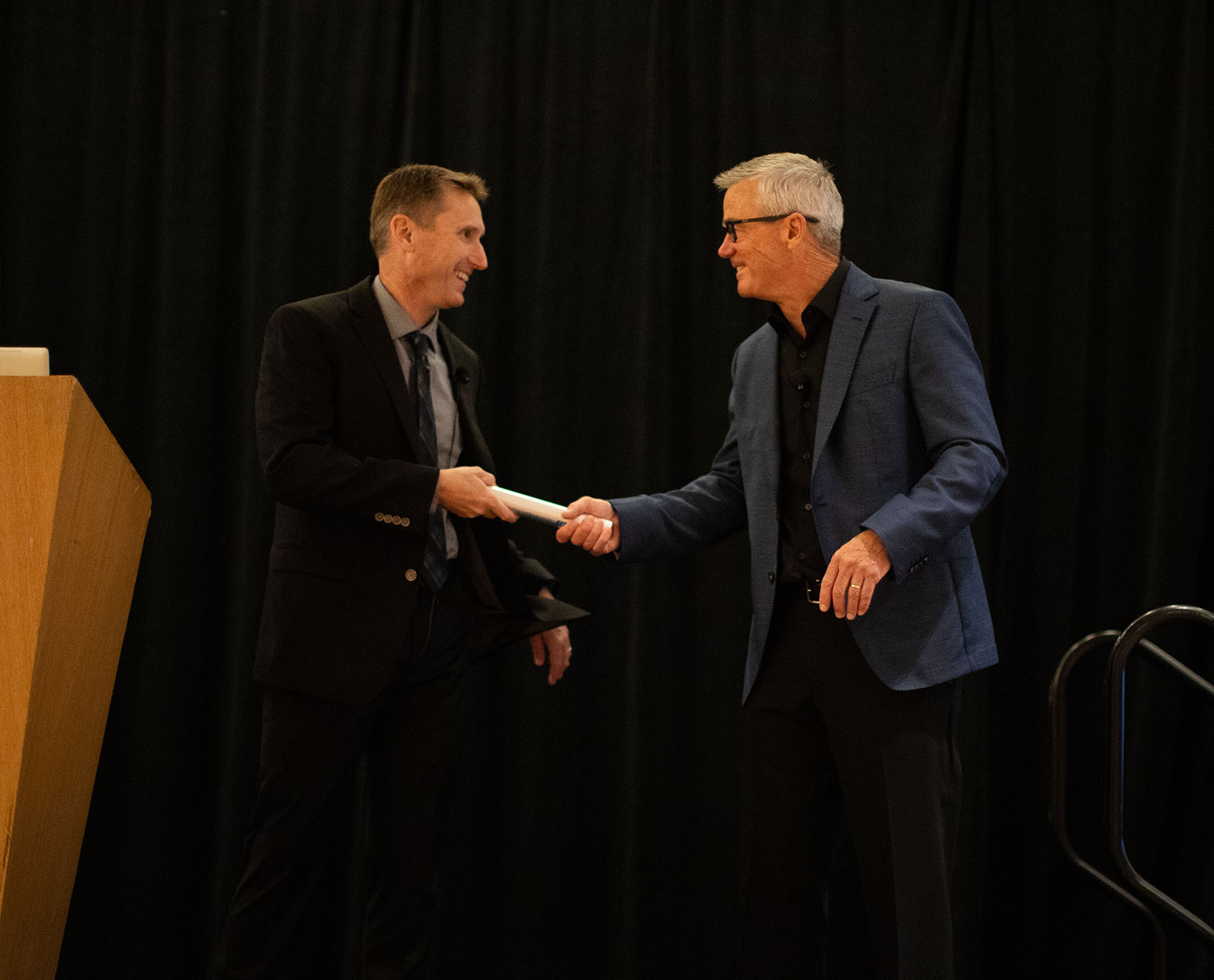
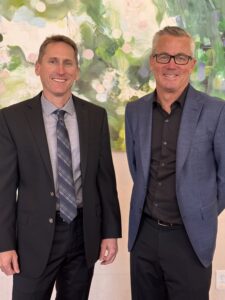
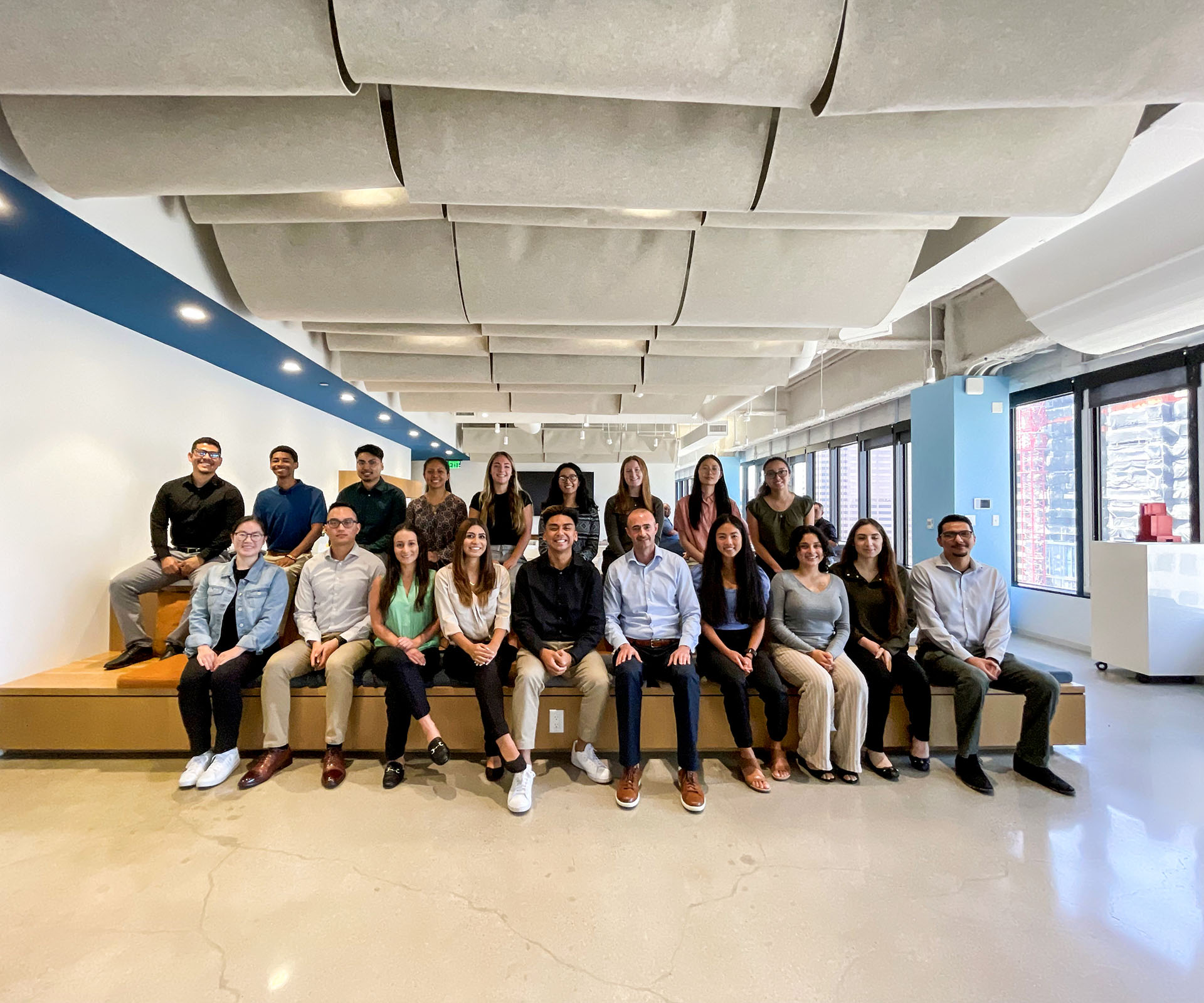
We’re excited to share an important milestone in KPFF’s leadership: Scott Kuebler has stepped into the role of President and CEO, effective June 6, 2025. Scott succeeds John Gavan, whose thoughtful leadership has left an enduring mark on our firm.
At KPFF, leadership transitions are rooted in our commitment to Stability and our responsibility to plan ahead for the future of our people, clients, and partners. This change reflects years of deliberate planning, collaboration, and care, with John and Scott working together closely.
To ensure continuity and a smooth transition, John will take on the role of Executive Chair, offering his guidance and support as Scott begins this next chapter. “Scott is gifted both at empowering others to bring their best and in building systems that support a growing organization,” John said. “He is the right leader to balance independence and support for our talented team at scale.”
Scott brings 27 years of experience and a deep dedication to KPFF. He’s a trusted voice and a proven leader. Known for his expertise as a Structural Engineer, Scott has played a central role in bringing innovative solutions to our clients while consistently advancing KPFF’s mission of engineering excellence. He has led our Special Projects Group since 2021. “It’s an incredible honor to step into this role,” Scott shared. “I’m now in my 28th year at KPFF, and I have deep respect for the people who make this organization what it is—our leaders, our staff, and those who came before us.”
Scott understands the rhythm of this organization, and we’re confident he’ll guide us into a future full of opportunity and growth. As Scott looks ahead, he’s energized by the path forward:
“What gets me most excited about KPFF’s future is our incredible people who show up every day to make a difference for our staff, our clients, and our communities. The freedom and support we provide to help our people achieve their full potential differentiates KPFF and fuels us to do great things. I really believe there’s no limit to what we can achieve if we stay committed to empowering our people.”
We would also like to take a moment to recognize John for his incredible contributions during his time as CEO. John’s steady leadership has shaped KPFF into the organization it is today, ensuring we remain rooted in our core values as we continue to grow and evolve. Over his 14 years as President and CEO, KPFF has doubled our number of offices and the size of our staff. Our ownership group grew from 60 to over 100, and our revenue tripled. John also helped define our purpose and vision, guiding KPFF’s future. In Scott’s words:
“John’s legacy comes from the influence he had in preparing the next generation of leaders to perpetuate KPFF. The most essential mark of a great leader is leaving things better than you found them – and John has done exactly that. We’re deeply grateful for John’s commitment and the lasting impact he’s had on all of us.”
Please join us in celebrating John’s legacy and in welcoming Scott to this new role. Together, we’re entering an exciting chapter for KPFF.
We’ve always had some form of an intern program, but it wasn’t as robust as our intern program today. Largely unstructured, no one knew what to do with the interns and no one was monitoring their success. The interns were bored, and we weren’t benefiting from them as part of our team.
In 2016, Mike Dygean created a more focused approach to the intern program on his team. He hired two summer interns and developed the Intern Design Project (IDP) to give the interns something to do when they didn’t have a task. “We needed something that was real, live engineering and something to judge their skills on,” he says.
8–10 WEEK INTERVIEW
When KPFF LA-S moved to Downtown Los Angeles in 2018, the intern program was refined further. We struggled to hire entry-level engineers, and those we did hire had a 50% turnover rate. Could we use our intern program as an 8–10 week interview to see if the interns were a good fit as full-time employees?
“That’s what I tell my interns,” Neil Bahen shares. “It’s a two-way interview for sure.”
“It’s our interview process for them, but it gives the person a deeper insight into what they would be doing as an Engineer,” Mike adds. “It’s them interviewing us. The interns appreciate that.”
This approach has proved successful: roughly two-thirds of our interns return either as repeat interns the following summer or as full-time employees.
FURTHER REFINEMENT
During the pandemic, the intern program became more defined. While we were fully remote, we were able to have interns living in other geographic locations. But when it was time to return in-person, there was a need for further refinement.
Team leaders expressed concern about Juniors and even some Seniors joining our team. But Juniors are arguably the most essential interns. “Juniors go back to school with one year left to the same University we want to hire from, and they talk,” Mike explains. “Let’s see if we can get more people applying from these schools.”
And so far, it’s worked – the 2022 Summer Intern Class was the largest class to date with 20 interns!
To accommodate the younger engineers, we interviewed the team leaders and created a wish list. From this list, we developed the Crash Course Series to get engineers up-to-speed so they could jump into projects right away.
In addition to the crash courses, interns also had emotional intelligence, core strengths, and crucial conversations trainings, in addition to other summer activities throughout the office.
TOO MUCH OF A GOOD THING?
Our intern program has evolved into a robust career training experience. As Jeanne Li covered in Epic Summer Part 1, our 2022 summer internship included design Crash Courses in topics such as steel and concrete, Entry Level Training seminars, an Intern Design Project, emotional intelligence training (Core Strengths, Crucial Conversations, DEI training), site visits, client meetings, and of course, real project work.
We may have gone too far last year. With a record size Intern Class and a robust learning schedule, the intern exit interviews showed many interns felt overwhelmed. While the 2023 Intern Program will have fewer trainings, they are not going away completely.
“We’re just sliding it into our Design Engineer training.” Neil shares. “As you’re transitioning in your career from intern to design engineer, there are even more trainings you’ll get from us as a full-time employee. At KPFF, the learning never stops.”
Mike adds, “Ultimately, we’re looking to fine-tune it so everyone has a beneficial summer.”
READY FOR AN EPIC SUMMER?
Are you interested in joining the KPFF LA Structural team for your internship? Applications are now open, just click here to view and apply!
Featuring Suha Hussain, Clayton Sumner, Courtney Huitt, and Kiana Sarad
In Part 2 of our Epic Summer Series, which looks at our Intern Program, we reached out to our current interns and an intern who later became full-time employees for their perspectives on the program.
The KPFF LA Structural Intern Program was restructured in 2018 (more on that in a future blog). Last summer, we ran the numbers: 67% of LA Structural interns either return the following year as repeat interns or join KPFF after graduation as full-time employees.
GETTING IN THE DOOR
Before our interns become interns, they have to find us first. And how exactly do our interns (and full-time employees, for that matter) find us? We asked some of our current interns to share how they discovered KPFF.
Suha Hussain, a current Cal Poly SLO student and first-time intern, shared she started with LinkedIn, cross-referenced her findings with online ratings, and talked with her friends who had previously interned with LA Structural. “Most of the firms I interviewed with were civil engineering only or land development,” she shares. “ I wanted exposure to true structural engineering before deciding on a focus for my senior year.”
Courtney Huitt similarly found KPFF via LinkedIn, though she had a slightly different approach: “I go to Cal Poly SLO, so I looked at the recent Cal Poly alumni – where they interned and now work full time. A lot of Alumni work at KPFF.”
THE DECIDING FACTOR
Most of our interns interviewed with multiple firms but ultimately decided on KPFF, but every intern’s deciding factor was different.
“I was originally trying to find something at home in Colorado,” Clayton Sumner explains. “In the Structural Engineering world, you have to worry about seismic, and Los Angeles is the best of the best. If you work in California, you can pretty much work anywhere.”
Courtney describes how the program’s overall structure appealed to her: “The crash courses, the entry-level seminars, and the Intern Design project the Interns would participate in throughout the internship were appealing to me. I’m a younger intern – I haven’t graduated yet, so I knew I wouldn’t have a ton of experience. The idea of having all these classes, I thought this would be the internship I would learn the most.”
GETTING HANDS-ON EXPERIENCE
The interns found us, interviewed with us, and chose to work with us. So what does a day in the life of an intern entail? From weekly lunch-and-learns to the intern design project and summer activities, there’s always something to engage our interns.
“This was my first time doing design work,” current employee and former intern Kiana Sarad explains. “I was given a lot of responsibilities as an intern. KPFF allowed me to bridge the gap between what I learned in school and what is done in the industry.”
“I didn’t expect so many activities in the office!” Suha adds. “The picnic, the Summer Olympics, the Wellness Challenge. Everyone’s enthusiastic. They want to have fun.”
Clayton shares his involvement in several types of projects “I spend a lot of time in etabs, I’ve done equipment anchorage and retaining walls, a structural analysis of an existing building. I’ve made a small impact on some big projects.”
THE CULTURE
The SDI and Crucial Conversations trainings surprised Suha. “I tried stepping into leadership roles such as student government to learn these skills. I never thought I would get that in engineering.”
Clayton agrees, “The culture was evident from the first initial conversation. Very inclusive and encouraging of everybody with the practice groups and soft skills training.”
“There are a lot of interns, at least in LA Structural,” Courtney adds. “I enjoy being able to interact with peers my age in the same program I am and working together to figure things out.”
FINAL THOUGHTS?
When asked if our interns would return next summer, they responded with a resounding YES. Suha shares, “During the time we’re here, we’re treated like full-time employees. I don’t feel like I’m just an intern.”
“At the end of the day, the reason I came back as a full-time employee was the people,” Kiana laughs. “It’s so cliche, but it’s true.”
Top Image: National Intern Day Breakfast Bottom Image: KPFF Polytechnic State University San Luis Obispo 2022 Summer Interns: Audrey Williams, Courtney Huitt, Suha Hussain, Rebecca Cortes, Clayton Sumner
As we do every summer, KPFF LA Structural welcomed our 2022 Summer Intern class to explore the world of structural engineering and experience our interactive office culture. This summer, we have twenty interns. While the stereotypical tasks of an intern may include getting coffee, moving boxes, and making copies all day, this didn’t fit into KPFF LAS’ long-term vision or mission. We want our interns to feel they’ve had a productive summer – learning skills on the job to help their academics and beyond.
During the first week of their internship, interns are assigned to an engineering team and a live KPFF project. To bring the Interns up to speed and provide them with the skills needed to contribute to these projects successfully, we created a comprehensive training program. By giving Interns these skills early in the program and connecting them with engineers at all levels, the interns can jump into projects immediately and experience what it is to be a structural engineer.
When I asked staff to gauge interest in leading the seminars, I was AMAZED how easy it was to find eager volunteers. We had 47 volunteers to conduct training sessions – 26 veteran trainers and 21 new trainers for the Crash Course series! The trainers range in experience from new engineers to 25-year engineering veterans.
This enthusiasm exemplifies our “Forefront” philosophy. Forefront, our education philosophy, provides a supportive and positive environment to make it happen. The forefront experience starts the day you walk in the door at KPFF and continues as a career-long effort to help us all advance and grow together. Engineers at all levels bring something to the table and can be resources to their colleagues.
Putting together a training series or revamping one from previous years is no easy task. Trainers met weekly for several months to create outlines, models, reference guides, practice examples, and PowerPoint slides; and then performed dry runs of the material before the first training session. Although our office was busy overall, the level of effort and attention to detail in this training was unparalleled.
At the beginning of this calendar year, when discussing how to improve our intern training program, we met with the Team Leaders since they are the ones who train the Interns and assign the engineering tasks. We incorporated the feedback into our 2022 Intern Training Program, which features the following components:
ENTRY LEVEL CRASH COURSES
Entry Level Crash Courses are a new addition to the 2022 training schedule, intended for new engineers and interns coming right out of school. Ideally taken during the first week of employment or their internship, these practical trainings include elements of structural engineering design. The Interns and new hires are brought up to speed faster and can jump in on projects more confidentially.
We intentionally recruited junior trainers for the Crash Courses – they are closer to the actual numbers, spreadsheets, etc., and can offer more recent lessons learned than some of the more senior engineers. Additionally, most of the junior engineers are naturally younger, and we felt they would be more approachable as another resource in the office the Interns could refer to for questions.
ENTRY LEVEL SEMINARS
Upon completion of the Crash Courses, the Interns attend the Entry Level Seminars, which are provided for all new KPFF LA Structural Engineers. These Seminars cover structural engineering topics in more depth and offer insight on professional development at KPFF, relationship intelligence, and other aspects of the Architecture, Engineering, and Construction (AEC) industry.
INTERN DESIGN PROJECT
We provide our Interns with hands-on experience on real-life KPFF LA projects, but since we only have them for 8-12 weeks, they will not see the project through completion. The Intern Design project gives interns experience on every project level – from concept through completion – on an accelerated schedule to fit within the summer program.
Our Intern Design Project changes each year and is based on a completed KPFF LAS project. The Interns are tasked with developing an ETABS model, analyzing the building and proposing a retrofit scheme, and then presenting their project to their team at the end of their internship. Interns are provided with weekly training sessions and an assigned liaison for support.
Structural engineering is about continuous learning and then learning some more! We hope out interns feel like they made strides in their professional development while enjoying themselves during their time at KPFF. If not, we hope they take the opportunity during their exit interviews to provide honest feedback so we can improve our program for next year’s interns!
As our industry looks for ways to change its landscape to create opportunity for all, we also need to expand the capacity of individuals to perform in leadership roles within organizations.
While efforts to recruit from and build AEC awareness within our underrepresented communities are of critical importance, we cannot lose sight of the diverse and talented people working alongside us every day. Action is required to make sure they are supported, sponsored and included in an authentic, meaningful way. In the words of 2021 Participant Matthew Trotter,
“Leaders aren’t born. They are taught, they’re made, they’re created, they’re cultured.”
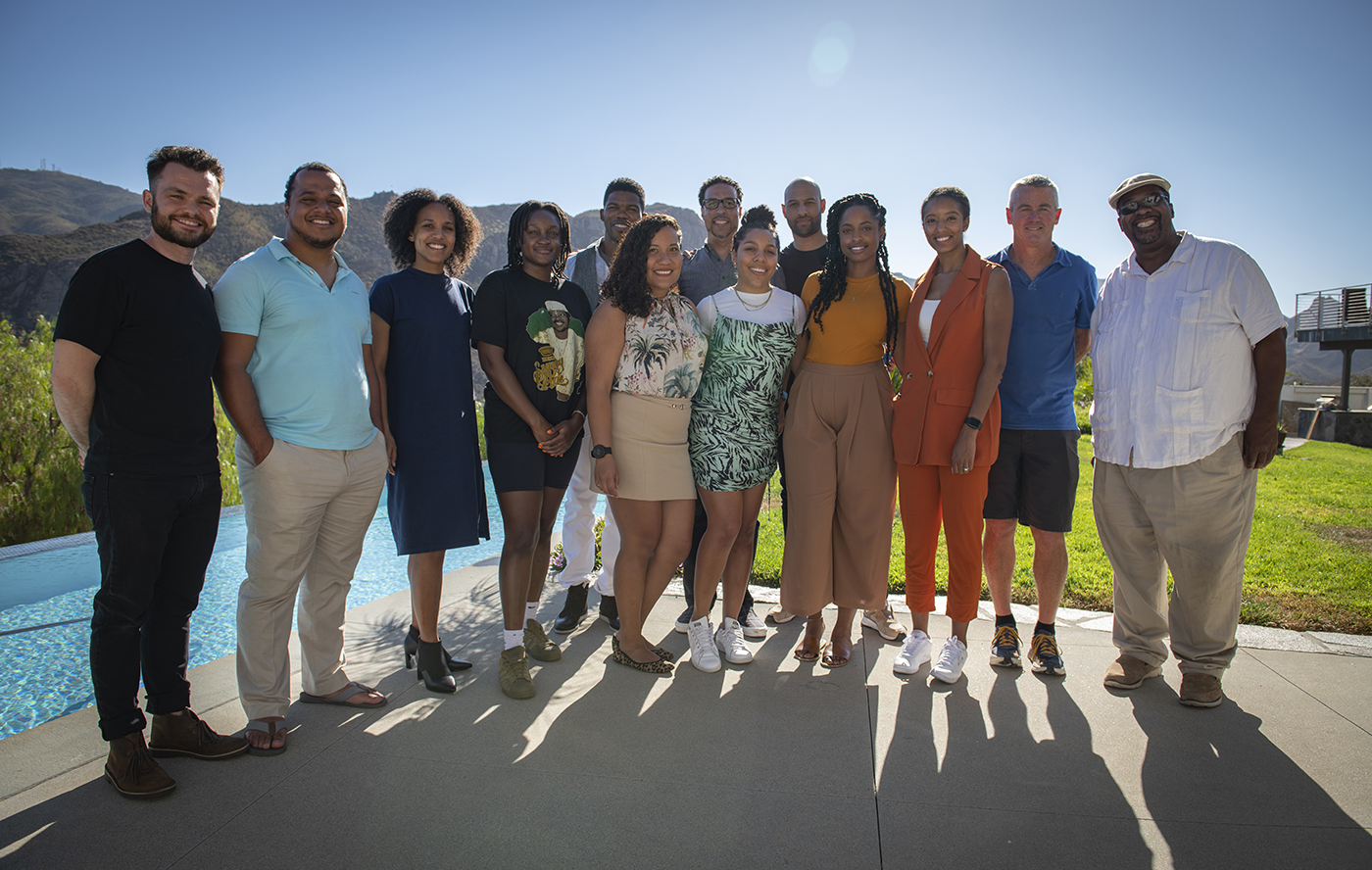
With that in mind KPFF led the creation of a new Leadership Development Program in collaboration with the Southern California Chapter of the National Organization for Minority Architects (SoCal NOMA). The initial cohort of twelve influential professionals from architecture, engineering, and construction came together to build their skillsets, forge important relationships, and make meaningful connections with leaders in our local industry.
Ample time was reserved for dialog around shared experiences, creating an environment of understanding and respect. Openness and vulnerability came naturally, as exhibited by Janiece Williams, 2021 Participant – “I felt like I could be myself, like I could be transparent, like I could be emotional if I needed to. It’s almost like therapy for your career. It was exactly what I felt like I was missing.”
Leadership is learned primarily by doing, with reinforcement and training that this program offers.
Activating underrepresented voices equips managers and teams to explore the impact on perspectives, assumptions, and approaches, and identify ways to enhance the contribution of all. “When you learn from people different than you, you start to grow in a different pattern or direction than you would have expected.” – Rachel Bascombe, 2021 Participant
This is just the beginning of a sustained effort to helping underrepresented talent thrive in our industry and hopefully ignite this type of program nationally. “This is really one step in a big puzzle of things we are all trying to address.” – Lance Collins, 2021 SoCal NOMA President
Learn more about this program in this informative video.
Our site uses cookies to enhance the viewing experience. By continuing to browse our site, you agree to our Privacy Policy.