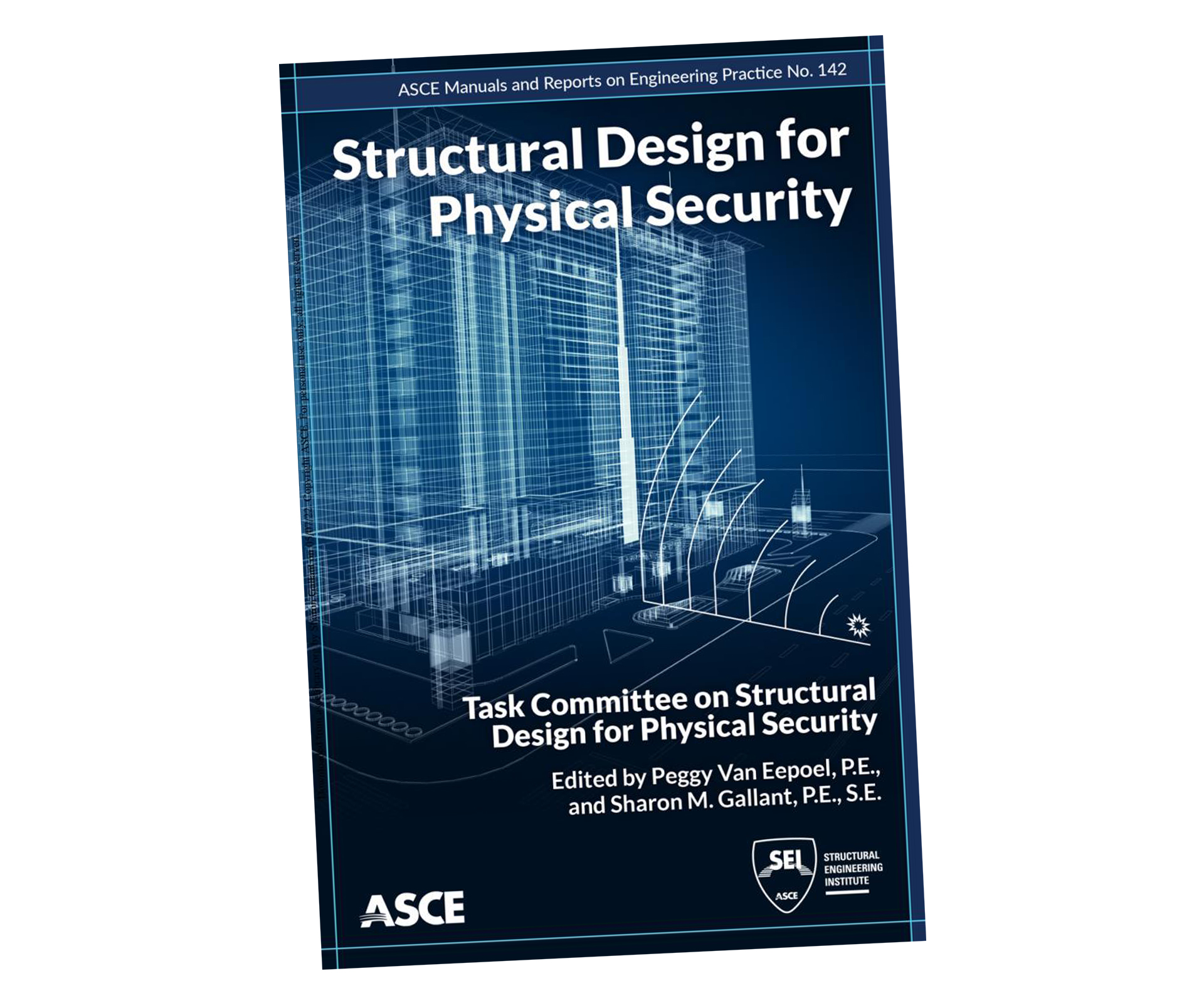
The first update since 1999, Protective Design Managing Principal Sharon Gallant acted as an editor in collaboration with the Task Committee on Structural Design for Physical Security of the Blast, Shock, and Impact Committee of the Dynamic Effects Technical Administration Committee of the Structural Engineering Institute of ASCE.
Structural Design for Physical Security, MOP 142, provides an overview of the typical design considerations encountered in new construction and renovation of facilities for physical security. The constant change in threat tactics and types has led to the need for physical security designs that account for these new considerations and anticipate the environment of the future, with flexibility and adaptability being priorities. This Manual of Practice serves as a replacement for the 1999 technical report Structural Design for Physical Security: State of the Practice and is intended to provide a roadmap for designers and engineers involved in physical security. It contains references to other books, standards, and research.
Topics include:
Threat determination and available assessment and criteria documents,
Methods by which structural loadings are derived for the determined threats,
Function and selection of structural systems,
Design of structural components,
Function and selection of window and façade components,
Specific considerations for retrofitting structures,
Testing methodologies, and
Bridge security.
This book is a valuable resource to structural engineers and design professionals involved with projects that have physical security concerns related to explosive, ballistic, forced entry, and hostile vehicle threats.
As our industry looks for ways to change its landscape to create opportunity for all, we also need to expand the capacity of individuals to perform in leadership roles within organizations.
While efforts to recruit from and build AEC awareness within our underrepresented communities are of critical importance, we cannot lose sight of the diverse and talented people working alongside us every day. Action is required to make sure they are supported, sponsored and included in an authentic, meaningful way. In the words of 2021 Participant Matthew Trotter,
“Leaders aren’t born. They are taught, they’re made, they’re created, they’re cultured.”
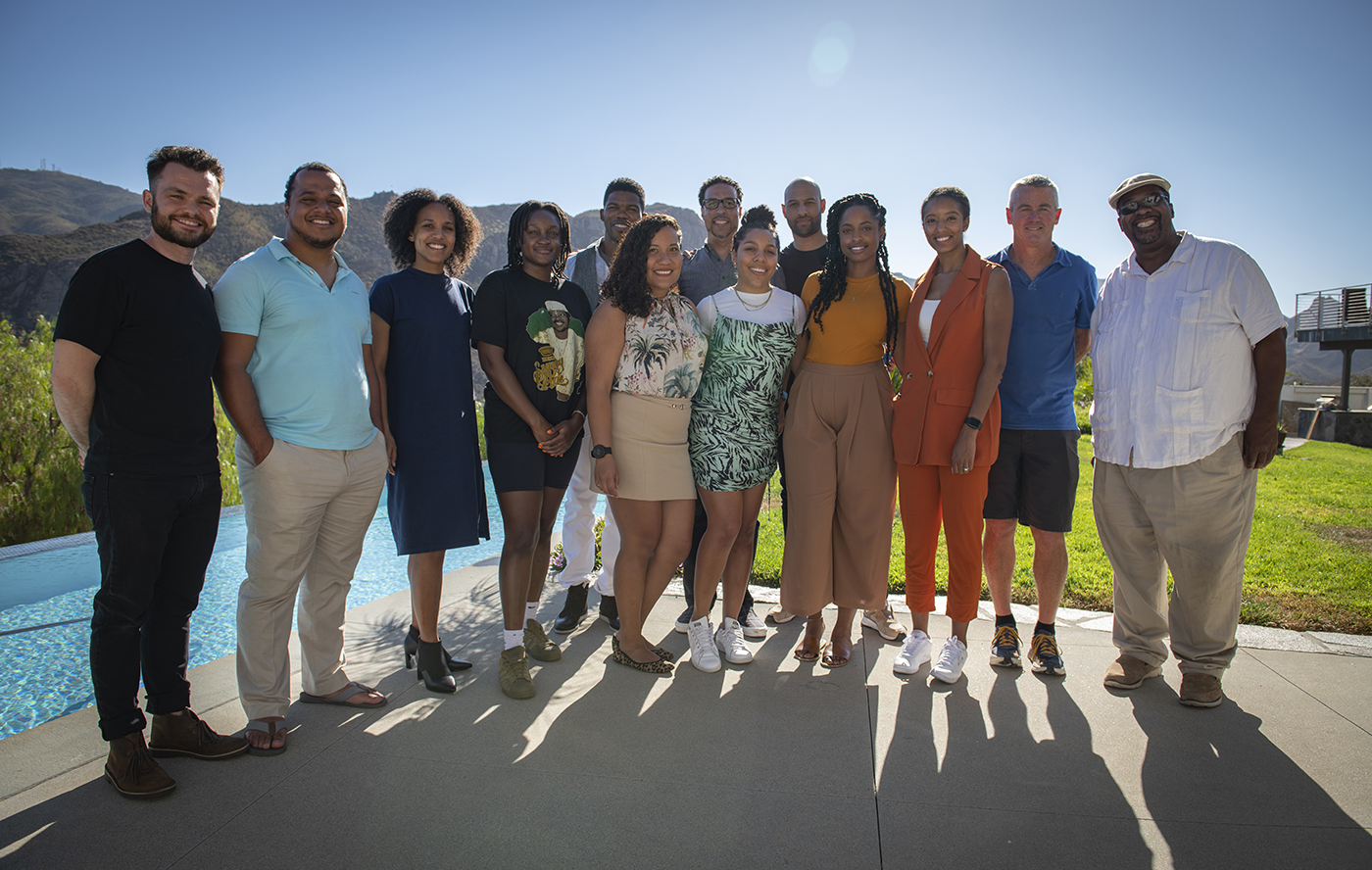
With that in mind KPFF led the creation of a new Leadership Development Program in collaboration with the Southern California Chapter of the National Organization for Minority Architects (SoCal NOMA). The initial cohort of twelve influential professionals from architecture, engineering, and construction came together to build their skillsets, forge important relationships, and make meaningful connections with leaders in our local industry.
Ample time was reserved for dialog around shared experiences, creating an environment of understanding and respect. Openness and vulnerability came naturally, as exhibited by Janiece Williams, 2021 Participant – “I felt like I could be myself, like I could be transparent, like I could be emotional if I needed to. It’s almost like therapy for your career. It was exactly what I felt like I was missing.”
Leadership is learned primarily by doing, with reinforcement and training that this program offers.
Activating underrepresented voices equips managers and teams to explore the impact on perspectives, assumptions, and approaches, and identify ways to enhance the contribution of all. “When you learn from people different than you, you start to grow in a different pattern or direction than you would have expected.” – Rachel Bascombe, 2021 Participant
This is just the beginning of a sustained effort to helping underrepresented talent thrive in our industry and hopefully ignite this type of program nationally. “This is really one step in a big puzzle of things we are all trying to address.” – Lance Collins, 2021 SoCal NOMA President
Learn more about this program in this informative video.
After years of the AEC industry working towards eliminating the operation carbon of buildings, the focus has started to shift to reducing embodied carbon associated with the building materials. As the carbon emissions related to structural materials can amount to up to 80% of a building’s total embodied carbon footprint, structural engineers will have a large role to play in making these reductions.
KPFF was a signatory of the Carbon Leadership Forum’s 2018 Structural Engineers 2050 Challenge and are now a signatory of Structural Engineering Institute (SEI) Structural Engineers 2050 (SE 2050) Commitment Program which states that:
“All structural engineers shall understand, reduce and ultimately eliminated embodied carbon in their projects by 2050.”
The goal of SE 2050 is ambitious, and SEI recognizes “the needs for coordinated action across our profession to achieve the globally stated goal of net zero carbon by 2050.” The program is challenging structural engineers to educate themselves, our clients and the public in embodied carbon in building materials and drive the momentum to have new technology developed to help us reach our 2050 net zero goal. We, at KPFF, are dedicated to being a part of the solution.
As citizens of this planet, many of us are doing our best to reduce our personal carbon footprint to help combat climate change, and as practicing structural engineers, reducing embodied carbon in our designs is one of the biggest impacts we can make.
The KPFF Embodied Carbon Action Plan is central to our commitment to SE 2050 and to the path to net zero embodied carbon structures. View in its entirety below.
Caltech Bechtel Residence and Integrated Project Delivery
True Integrated Project Delivery (IPD) construction projects are rare and require an exceptional team to deliver the rigorous demands of a collaborative team that utilizes lean methodology to maximize operational efficiencies while working under a multi-party risk/reward contract. It takes an extraordinary building to inspire such a team, led by efforts from the Caltech ownership team, to create a new typology of on-campus living.
The 211-bed Bechtel Residence, named after life trustee Stephen D. Bechtel Jr., kicked off in 2016 and was officially opened September 17, 2019, as the first new undergraduate housing facility to open on campus in over 20 years. Caltech approached the program with the goal to provide housing for all of their undergraduate students on campus for the duration of their studies. This multi-use residence houses undergraduates from all class levels along with two faculty in residence, a half-dozen graduate resident associates, and a residential life coordinator. This new construction frees up off campus space for graduate student housing, enhancing student life both on and off campus.
Photo by Bruce Damonte
The IPD delivery included a Tri-Party agreement between Caltech and our construction and design partners MATT Construction and ZGF Architects. KPFF was part of the Risk/Reward Team under the architect’s prime IPD agreement and participated in the Incentive Compensation Layer (ICL) of the contract. The design and construction team depended on trust and financial transparency of each team member as individual profit for each team member depended on the overall performance by the team to meet the Final Target Cost at the construction completion of the project. This agreement kept the team focus on clear communication and collective problem solving in a supportive environment to achieve the required milestones. The design of the new residence encourages and enhances the collaboration and communal housing culture already on campus, while simultaneously offering residents new types of dormitory spaces intended for maximizing the collective experience.
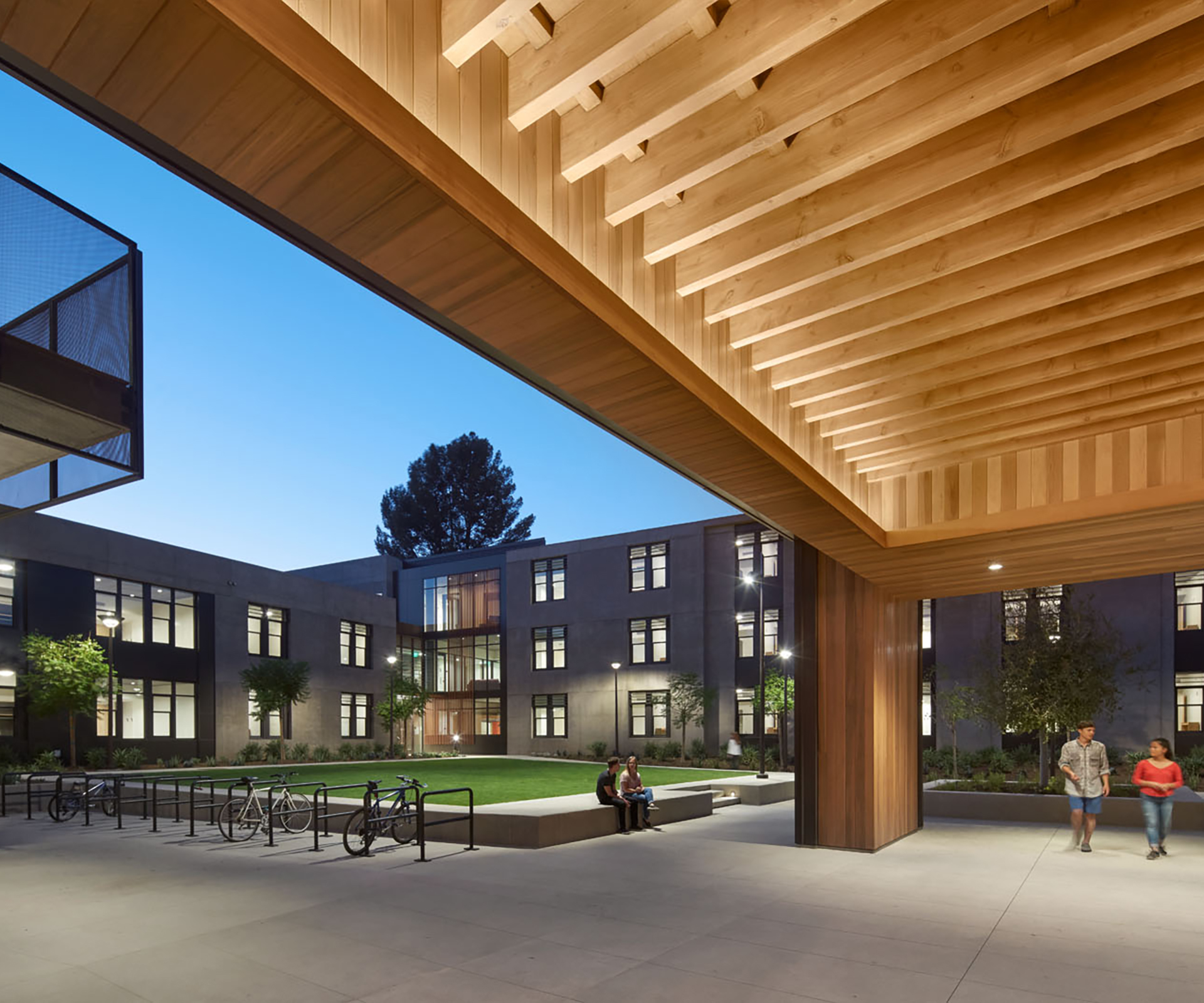
The six distinct buildings that make up the compound are all three-story structures surrounding a protected courtyard that acts as an outdoor living room. Influence by the landscape of the Pasadena area, the 105,000 SF buildings work seamlessly together to respond to site conditions, bring variability and visual interest from any vantage point. Student bedrooms are organized into suites of four to 12 with shared facilities such as restrooms and living spaces. Like many luxury multifamily complexes built today, there are a variety of amenity and community spaces including kitchens, lounges, conference rooms and study areas of different sizes. A beautifully appointed dining facility provides a sense of community, and an anchor for the residences.
Photo by Bruce Damonte
Photo by Bruce Damonte
This LEED Platinum® building has been designed to achieve net-zero energy, utilizing sophisticated and cutting-edge sustainability solutions that were seamlessly integrated into the design. The building is fully powered by a series of hidden rooftop photovoltaic panels. By maximizing clever systems, such as siting of buildings, an open courtyard, material choices and thermal lag in the structure itself, the design team minimized solar heat gain, and coupled with the use of active chilled beams for interior climate control, the energy needs of the building have been significantly reduced. Water is problematic in arid Southern California, and so the building was designed to be net-zero water-ready. Piping and water reuse systems are built in for future needs, should water shortages become a significant issue.
The structure of the residential buildings consisted of a concrete shear wall building with a conventional reinforced concrete flat slab system supported by concrete columns. The concrete walls, columns, and slabs remained primarily exposed in the building and were architecturally featured and highlighted as part of the aesthetic intent for the building. Concrete construction was selected to meet not only for the durability goals of the building but also to contribute to the sustainability goals of the project. Since the production of cement is responsible for approximately 5% of the carbon dioxide emissions worldwide, some of the concrete mixes for the concrete elements on this project used fly ash as a replacement for the cement content in concrete. Fly ash is recycled product primarily collected from the bi-product that is produced by coal-fired and steam generating plants, and is estimated that for each pound of fly ash used instead of cement, one pound of carbon dioxide emissions can be saved.
Boise State University Micron Center for Materials Research
How do you take a nationally recognized material science department and turn it into a world class research institute?
This is the question that Boise State University found itself trying to answer. The solution they came up with took a line right out of the movie, Field of Dreams:
“Build it and they will come.”
Boise State University set out to build a world-class research and educational facility for its Material Science Department that would attract the best and brightest researchers and students in the field.
How?
To attract top talent, there were 2 main goals for the new building:
Create a world-class lab facility capable of supporting high-end research and hosting some of the most precise and sensitive equipment in the world (like high-powered electron microscopes).
Create a beautiful, inviting, and functional space with faculty offices, a lecture hall, and classrooms. To attract and retain the best and brightest, a space was needed that they would enjoy working in.
Who?
Hummel Architects partnered with Anderson Mason Dale Architects to lead the design and Hoffman to lead the construction. Hoffman was brought on early in design as the construction manager, enabling collaboration between the construction and design teams as the design was being developed.
KPFF joined the team as the structural subconsultant to enable the architect and contractor to create this vision.
What?
World Class Lab
In order to allow the type of research done by the best and brightest in the field of material science, the new lab building needed to support some of the most precise and sensitive research equipment in the world.
This is no easy feat! When looking through a microscope at something as small as an atom, even the slightest vibration in the building will blur the image. Vibration was the biggest issue we needed to deal with for the lab portion of the design.
While we certainly had experience with vibration design in our Boise office, we had not done a vibration design to this level. Fortunately, KPFF has many resources, and an industry leader on vibration in structures, Dr. Andy Taylor PhD, SE, FACI, is an Associate in KPFF’s Seattle office. (Andy is so passionate about building vibration that his favorite hobby outside of work is to roam around Seattle with an accelerometer measuring the vibration of different buildings… or so the legend goes.)
One of my favorite things about working at KPFF is that everyone across the company is willing to help each other out. This allows us to leverage the huge amount of technical expertise across our 1,200-person company to solve challenges that a company with a smaller bench would struggle with.
Dr. Joel Parks performed the vibration design for our Boise office and collaborated closely with Andy Taylor.
At the elevated floors in the lab building, the primary concern that drove vibrations was footfall. We ended up using a 15” thick mildly reinforced 2-way concrete slab floor system to provide the mass and stiffness needed to bring vibration within the equipment tolerances. That’s one thick hunk of concrete! This was supported vertically by concrete columns and laterally by special concrete shear walls.
The most sensitive equipment, including a STEM unit that is one of only two in the country, is located at the ground level. While we did provide a thick slab-on-grade below this unit that was isolated from the rest of the building slab, there is only so much you can do with concrete. If the entire ground shakes due to a truck driving by, we would be out of luck.
To help solve the ground floor piece of the vibration puzzle we brought on Byron Davis, a vibration consultant from Vibrasure. He performed a 24-hour vibration survey of the site and found that it is capable of meeting a VC-F (63µin/sec) rating, which is even better than the VC-E (125µin/sec) required by our most sensitive piece of equipment. He also provided recommendations for a thick slab-on-grade cast in a way to prevent voids in the grade below.
The other piece of the puzzle for the lab building was how to support the myriad mechanical units required to service the facility. To do this the roof was designed as a 14” thick 2-way concrete slab that supports a steel framed penthouse that contains the mechanical systems including air handling units, a chiller, many other large units and the associated pipe and duct distribution systems.
The lab isn’t all there is to the story, however. The best and the brightest have a lot of choices for where they will do their research. Our building needed to be a place that these folks WANT to spend time….
Inviting and Functional Faculty Offices and Classrooms
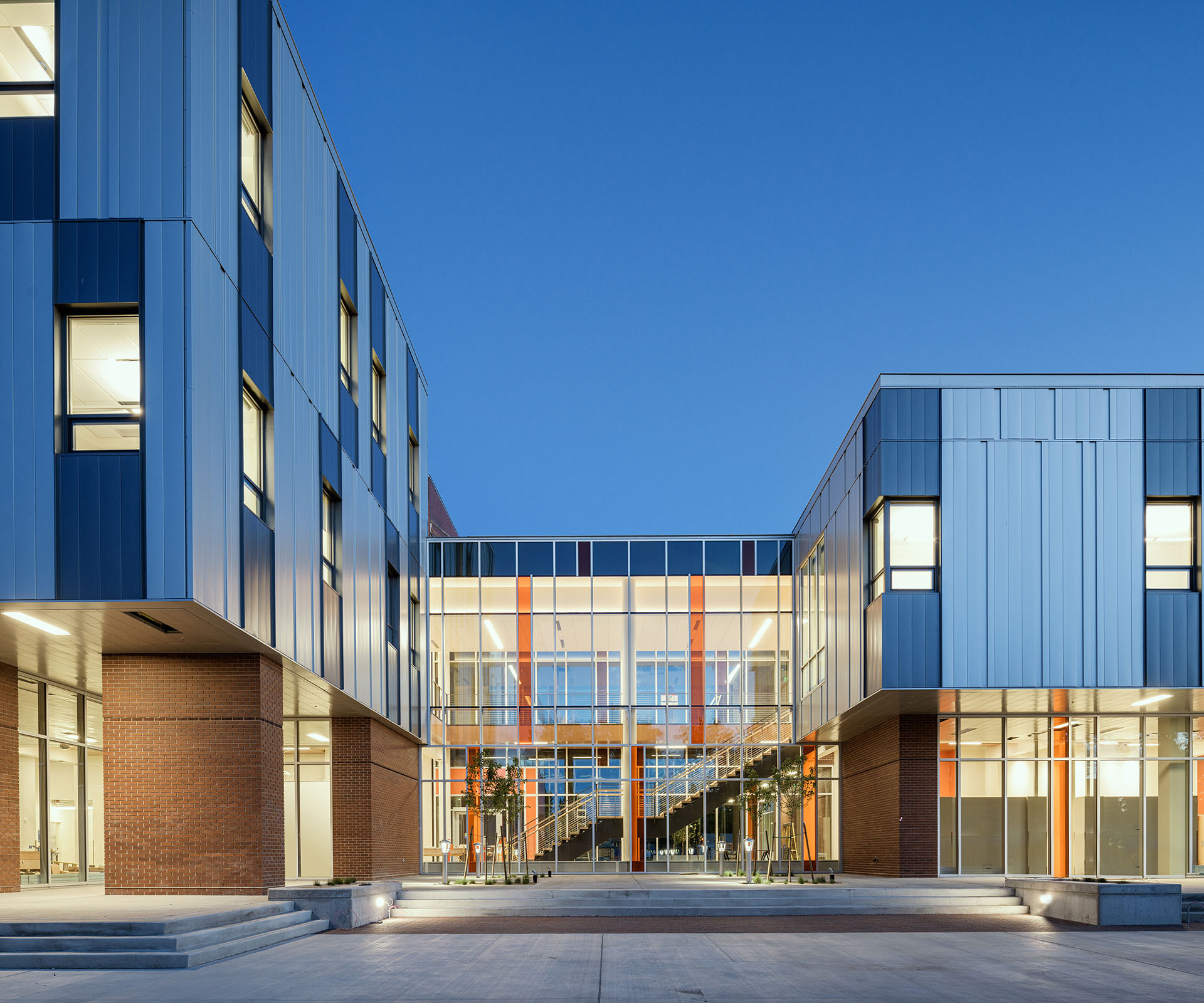
One of the ways Hummel and Anderson Mason Dale Architects achieved this was to keep the educational spaces and faculty suites separated, connecting them via a thin profile bridge walkway (See Figure 1). Arranging the building in this manner addresses the architectural goals but results in some interesting structural challenges around meeting design-level wind and seismic loads. If the educational space and the faculty suites do not move in unison – or in the worst case move in opposite directions – would the bridge be able handle the induced forces? To understand the forces this would place on the bridge, KPFF ran multiple structural analysis models looking at different scenarios. We came up with a creative structural solution to achieve the thin profile and narrow width the architects imagined while still providing the structural strength necessary to keep the two parts of the building attached during an extreme event. The solution was to create a horizontal truss using the floor framing that spanned between the two areas. This allowed the steel members to be as shallow as possible, but gave the narrow walkway ample structural strength.
Figure 1. BSU Material Science Classroom Block
The educational spaces consist of state-of-the-art teaching spaces, a 250-seat lecture hall, and two 80-seat classrooms. The two classrooms are located at ground level and are separated by a folding partition while the lecture hall is located above on the second floor. The lecture hall consists of elevated stadium seating and a tall open space free of columns to create a clear line of site to the front of the room. This large open space without columns necessitated a lecture hall roof that could span 85’-0” while supporting a 27,000-lb air handling unit. To accomplish this feat, we took advantage of a roof step to create an 11’-0” deep truss. By incorporating the truss into the already present roof step we were able to achieve the column-free lecture hall desired, while still being able to provide enough structure to support the adjacent air handler.
Conclusion
Throughout this project, the collaboration and sense of teamwork were amazing. During the design phase we came to work with smiles on our faces nearly every day. Not only was this project challenging and rewarding, it was a lot of fun. If you ever get the chance, stop by the Boise State University Micron Center for Materials Research and see the facility and its occupants in action.
Our site uses cookies to enhance the viewing experience. By continuing to browse our site, you agree to our Privacy Policy.